::: CONVENTION PERIOD :::
|
JULY 1, 1870 - DECEMBER 31, 1881
|
|
|
Mail exchanged between Hawaii and the United States was greatly simplified by a Postal
Convention signed May 4, 1870, effective July 1, 1870. This Convention:
- Created a single rate of 6¢ per ½ ounce for first class mail, fully paid with
postage stamps of the country of origin. See Mail Rates.
- Abolished collect or underpaid letters, stipulating they were not to be forwarded;
- Provided "each country shall retain to its own use the postages which it
collects" thus ending the accounting system with the San Francisco post office;
- Prohibited either country from adding internal fees for delivery of mail received
from the other (thus abolishing the Hawaiian 5¢ internal charge on foreign mail and the
United States ship fee);
- Specified many other details for exchanging mail including the style of postmarks
required and where they were to be placed on a cover.
I see the Convention Period as the "Neo-Classical" Period of Hawaiian postal history.
It retains the "innocence" of the Treaty Period in the sense that few fakes or
"philatelic inspirations" - genuine covers made to order for collectors - are known.
Mixed frankings, colorful stamp combinations, a proliferation of town cancels and an
interesting variety of Honolulu foreign mail postmarks are some of the reasons why this
Period should fascinate any student of postal history, as it does me.
The first mail bag sent from Honolulu in the Convention Period was postmarked July 23,
1870 and carried to San Francisco on the steamer Ajax, departing July 24 and arriving
San Francisco August 4. Hawaii joined the Universal Postal Union effective January 1,
1882. The Convention Period thus ended December 31, 1881. The last covers recorded were
carried by the steamer City of Sydney, departing Honolulu December 19, 1881. Two sailing
vessels departed Honolulu with mail between December 19 and January 1, the American
barkentine Jane A. Falkinburg on December 20 with 56 letters and the Hawaiian bark
Kalakaua on December 31 with 395 letters. Also, the British steamer Zealandia departed
for Sydney on December 27. No covers have come to light from sailings after the City of
Sydney until the new UPU rates were in effect.
Contract steam service continued into this period both to San Francisco and to
Australasia, terminating at either Sydney or Auckland. Neither service, was consistent.
Financial troubles and old steamers plagued the Australasian route in the early '70's
and the service actually was suspended from April, 1873 to January, 1874. Moreover, in
September, 1873, the steamer Costa Rica (the only steamer on the Hawaii - San Francisco
route) grounded attempting to enter San Francisco Bay in a fog and that service came to
a halt. Sailing ships and naval vessels filled the void until January, 1874, when
service between Sydney and San Francisco via Honolulu was commenced. Through several
route realignments between Auckland, Fiji and Sydney, Honolulu had continuous steam
service between San Francisco and Australasia through the balance of this Period.
Between Hawaii and San Francisco, the high volume of steamer and sailing ship traffic
usually offered multiple opportunities to forward mail each month.
HAWAIIAN STAMPS USED IN THE CONVENTION PERIOD
Hawaii continued using its 2¢ orange-red (Scott No. 31a) and 5¢ blue (Scott No. 32)
stamps until newly ordered stamps arrived in March, 1871. These stamps were the 1¢
mauve (Scott No. 30a), 6¢ yellowish-green (Scott No. 33) and 18¢ "burgundy"
(Scott No. 34). In 1875, after Kalakaua became king, new stamps were ordered with his
portrait on the 2¢ brown (Scott No. 35) and his brother's portrait on the 12¢ black
(Scott No. 36). These stamps are discussed in detail at
National Bank Note Company stamps.
The 2¢ stamps were primarily for use on domestic mail but are found in
multiples on foreign mail. The 1¢ stamp was for postage on newspapers sent either in
the domestic or foreign mail, or for the domestic drop mail rate instituted during this
Period. The higher value 6¢, 12¢ and 18¢ stamps were intended primarily for foreign mail.
Click here for Hawaiian Stamps used on Foreign Mail in the
Convention Period.
UNITED STATES STAMPS USED FROM HAWAII IN THE CONVENTION PERIOD
Need for keeping United States postage stamps on hand continued during the Convention
Period. One need was for mail to foreign destinations sent through the United States.
In order to take advantage of United States postal treaties, Hawaiians had to use
United States postage stamps for the rates to other countries. Also, the Convention
failed to address registered mail and it was necessary to prepay United States registry
rates with United States postage stamps. Finally, newspapers and other printed matter
still required postage stamps of both countries.
Click here for Convention Period Mixed Franking Covers To
Foreign Countries.
For several years, Hawaiian postal authorities resisted buying supplies of United States
stamps for sale over the counter because there was risk of loss and no profit. Only
enough United States stamps were purchased from local stationery stores to supply the
need of the Post Office on its own correspondence. During 1874, the Post Office began
ordering United States stamps in large quantities from the San Francisco Post Office
but still refused to distribute them to outlying post offices. Foreign mail originating
at a country post office and requiring United States postage was to have sufficient
Hawaiian postage put on it to pay the full postage rate. Clerks at Honolulu were to
remove the Hawaiian stamp and replace it with the correct amount of United States
postage. Finally, in April, 1880, a separate window was opened at the Honolulu Post
Office for sale of United States stamps over the counter and they were distributed to
outlying post offices.
FIRST CLASS MAIL TO THE UNITED STATES
|
|
|
Postmarked April 19 at Honolulu, this cover is the earliest known use of the 6¢ Hawaiian
Scott No. 33, paying full postage for delivery in the United States. This cover was
carried to San Francisco by the American bark Comet, departing Honolulu April 19, 1871,
arriving San Francisco May 7. The Honolulu postmark type is 277.12.
Click here for Honolulu Postmarks. A May 8 San Francisco transit mark is on the back. The "SHIP" mark
applied at San Francisco is the same marking found during the Treaty Period on collect
mail delivered to the San Francisco post office from a non-contract vessel.
Click here for San Francisco Postal Markings.
Why San Francisco used its SHIP mark on this cover is unclear. Perhaps the San
Francisco office was unfamiliar with the new postage stamp. Another reason may rest in
the arrangement for paying sea postage. When mail was carried by a non-contract ship
in the Convention Period, Hawaii was obligated to pay the sea freight. However, there
are many non-contract sailings and the SHIP mark was used only for this one. One other
cover from this same sailing of the Comet also bears the "SHIP" mark. Whatever stamp
once graced the other cover was cut out and replaced by a United States 10¢ stamp so we
cannot tell if it bore the 6¢ stamp originally.
MAIL TO OTHER COUNTRIES SENT THROUGH THE UNITED STATES
|
|
|
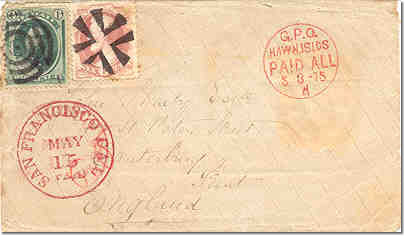
Postmarked May 3, 1875 at Honolulu and May 15 at San Francisco, this cover for
Canterbury, England, is franked with a United States 6¢ stamp (US Scott No. 159) to pay
the then treaty rate between the United States and England. The cover was carried by
the steamer Cyphrenes to San Francisco. Note this cover bears the Honolulu "PAID ALL"
postmark, type 233.24. It was received at Canterbury on June 2.
About July, 1875, Honolulu stopped using its regular foreign mail postmark on letters
for delivery to other countries. Instead, Honolulu postmarked those letters on the
back with its regular domestic mail postmark. In July, 1881, Honolulu again started
placing its normal foreign mail postmark on the front of covers destined for delivery
in countries beyond the United States, and continued to do so through the balance of
this Period. Why Honolulu stopped and later resumed the use of its regular foreign mail
postmarks on mail to other countries is unclear. When it stopped, the General Postal
Union had just been formed on July 1, 1875, with the United States as a member, but not
Hawaii. Perhaps the PAID ALL postmarks were thought to be confusing in light of GPU
practices. The GPU was replaced by the Universal Postal Union on April 1, 1879. When
Hawaii resumed using its foreign mail postmarks on mail to other countries, Hawaii was
itself applying for membership in the UPU and perhaps discovered its PAID ALL postmarks
were satisfactory after all.
|
|
|
Front and back of a letter destined for Coulon sur Mer, France. It is postmarked
November 12, 1875 on the back with postmark type 243.03 (after July 1, 1870, this type
was used only for domestic mail although it was a foreign mail marker in the Treaty
Period). In addition to the Hawaiian 6¢ stamp, this letter is franked with 9¢ United
States postage to pay the rate then in effect between the United States and France
(France joined the GPU in January, 1876).
REGISTERED MAIL
|
|
|
Postmarked February 25, 1875 and registered for delivery in the United States. Because
the Convention failed to address registered mail, it was necessary to pay the United
States registry fee with United States stamps. In this case, the United States
registry fee was 8¢, regardless of weight, so it was paid only once on this double
weight cover. A "silent" Hawaiian registry fee of 15¢ also was charged but paid in
cash so there is no indication of this rate on the cover.
Click here for Registered Letters.
NEWSPAPERS
|
|
|
This newspaper wrapper shows an example of the third way United States stamps were
required on mail during the Convention Period. This wrapper is postmarked February 17
and is ascribed to 1879 based on sailing tables, the postmark type (234.62) and the then
current 1¢ plus 1¢ rate for transient newspapers. The stamps are the Hawaiian 1¢ mauve
(Scott No. 30a) and the United States 1¢ (US Scott No. 156).
Please E-mail (scott312@earthlink.net)
me with information about other wrappers from the Convention Period.
OFFICIAL FOREIGN OFFICE MAIL
|
|
|
|
|
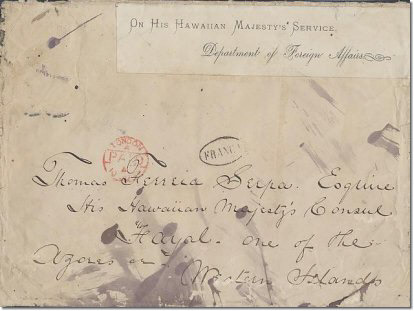
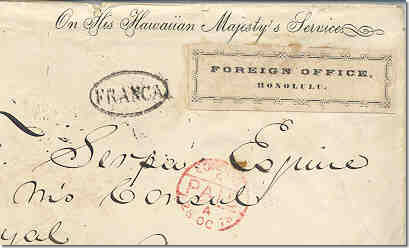
At least two styles of labels were used by the Foreign Office at Honolulu for its official mail. The handful of
known covers bearing a Foreign Office label all were mailed to the Azores. The upper image is cropped from a large
cover mailed at Honolulu on May 14, 1878; the Honolulu postmark on the back is type 222.02. The lower image, also
cropped from a large cover, was mailed from Honolulu on September 30, 1878; the Honolulu postmark on the back is
type 223.029. Both covers were treated as fully paid and traveled via San Francisco, New York, London and Lisbon.
For another cover with the Foreign Office label, see Aall Sale, Siegel Auction #805, lot 550. Please
E-mail (scott312@earthlink.net) me if you have information about
other covers with this label.
AUSTRALASIAN MAIL
Conventions also were signed with New Zealand and New South Wales. The New Zealand
convention was signed before March, 1871, and the only evidence of it found to date is
in internal post office correspondence in Hawaii. Please
E-mail (scott312@earthlink.net) me if you can shed further
information on this convention. The rate was 12¢ per half ounce, fully paid
in postage stamps of the country of origin, each country retaining the postage collected.
The convention with New South Wales was signed July 1, 1874. A rate of 12½¢ was
stipulated but in practice the rate charged was 12¢. Before this convention, rates are
unclear but the rate published in Hawaii was 12½¢ in April, 1871. A convention between
the United States and New South Wales effective in February, 1874, stipulated a rate of
12¢. Covers to Australasia in this Period before 1875 have not been found.
|
|
|
Postmarked with a New Zealand Marine PO mark dated April 11, 1881, this cover actually
was mailed on board the steamer City of New York, after its departure from Honolulu on
April 18. The postmark date was fixed at the steamer's departure for Sydney via
Honolulu from San Francisco on April 10 (adding one day to conform to the New Zealand
date) and was unchanged until the steamer reached Auckland. A letter mailed on board
was to be paid with postage stamps of the last port-of-call and according to the rates
in effect from that port. Thus this letter was franked with the Hawaiian 12¢ stamp and
was received at Dunedin on May 7. Only two covers to Australasia from this Period are
recorded (see Pietsch Sale - Shreve Auction, September, 1996 - lot 1339 for the other
cover, franked with six 2¢ stamps). Please
E-mail (scott312@earthlink.net) me with information about other
covers to Australasia during the Convention Period.
|

|
Detail of the New Zealand Marine PO mark. This mark is McNaughten type 5. See
McNaught, K.J., "New Zealand Marine Post Office Markings On Hawaiian Stamps", The
American Philatelist, Vol. 84, No. 9 [836], p. 793-795, Sept., 1970; reprinted at
Mitchell's Hawaiian Philatelist, Vol. 3, No. 2, p. 16-20, 1980, for a complete listing
of NZMPO marks found on Hawaiian mail.
|
|
CLOSED MAIL TO BRITAIN?
|
|
|
Here is a mystery. This cover is postmarked in London on February 21, 1881. A closed
mail system between Hawaii and Great Britain is documented from the Treaty Period. No
closed mail covers from that Period have been identified. I am unable to document a
closed mail system this late in time. This cover has no Honolulu or San Francisco
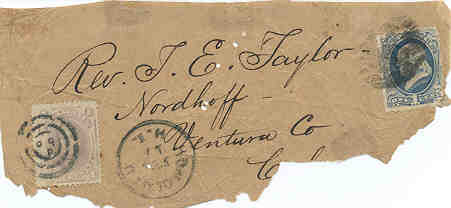
postmarks. The stamps appear to have originated on this cover and the cross-roads
cancels are of Hawaiian origin. Please
E-mail (scott312@earthlink.net) me if you can provide additional
information about a closed mail system between Hawaii and Great Britain in 1881.
FORWARDER LETTERS/LOOSE LETTERS
|
|
|
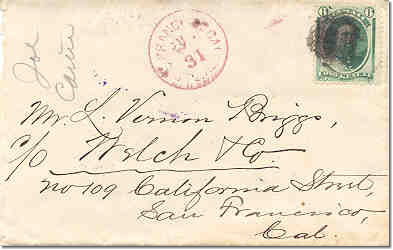
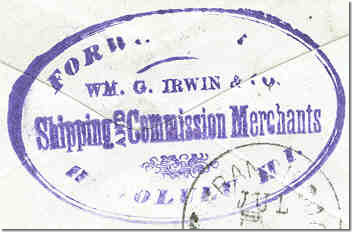
Front and portion of back showing the Irwin forwarder mark. This cover is postmarked
July 31 at San Francisco and bears no Honolulu postmark. It was carried on the
American barkentine W. G. Irwin, departing July 11, 1881 and arriving July 31. Loose
letters were implicitly prohibited by the Convention, but examples are known. Some,
such as this cover, were handled by forwarders but in order to prepay the postage with
Hawaiian stamps, the letter had to be in the official mail bag. How forwarders got mail
into the San Francisco post office fully prepaid with Hawaiian stamps is unclear.
INBOUND COVERS
Mail from the United States was supposed to be paid at the same 6¢ rate applicable to
mail from Hawaii.
|
|
|
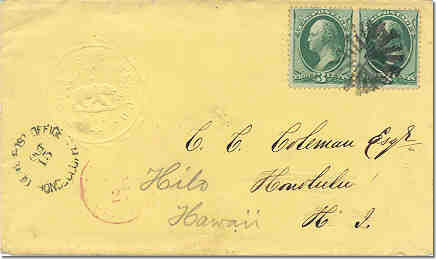
A typical inbound letter with 6¢ postage fully paid with stamps of the United States.
Hawaii was prohibited by the Convention from adding its 5¢ foreign mail rate on mail
received from the United States. This cover shows a Honolulu receiving postmark, the
domestic mark in use at the time. The Honolulu postmark was probably applied because
the letter was forwarded to Hilo because receiving postmarks typically are not seen on
inbound letters in this time frame. This cover belongs in 1877 based on the postmark
type and sailing lists.
Domestic mail could be sent throughout the United States for 3¢ and the need to add
another 3¢ for mail to Hawaii was forgotten by some people. We thus see short paid
covers to Hawaii. In some cases, the extra 3¢ was added as a courtesy by someone in a
post office in the United States. In other cases, mail was held for postage in San
Francisco. In those instances, a card was sent to the addressee to pay the extra
postage before the letter would be forwarded.
|
|
|
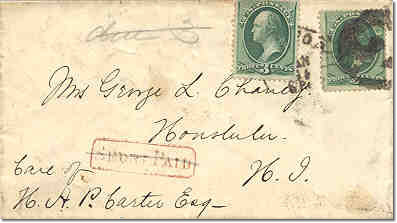
This cover bears a San Francisco "HELD FOR POSTAGE" lozenge because it was a double
weight cover and required an additional 6¢ postage. Given the manuscript note,
probably reflecting the dateline on the contents, and the April 15 San Francisco
postmark, it is probable someone in San Francisco (perhaps the Hawaiian postal agent or
consul) paid the extra 6¢ to avoid the delay in sending a card to Rev. Bond and waiting
for him to send the money.
|
|
|
Front and back of a short paid letter originating in the East. In this case, the extra
postage was paid by George Hopper, the Superintendent, Foreign Department, New York Post
Office, as reflected in a note he placed on the back of the cover.
INBOUND/OUTBOUND
|
|
|
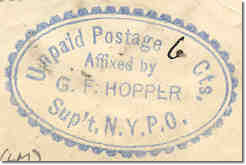
This cover was sent to Hawaii for transmission to Kusaie in the Caroline Islands and is
anther example of a short paid letter with the extra postage paid by George Hopper. By
now, Hopper had gotten a handstamp to show he added postage. Mail from Hawaii to the
mission stations in the South Pacific was carried privately. This cover is attributed
to 1881, based on sketchy data.
|
|
Detail showing the Hopper handstamp.
|
|
|
|
Another inbound/outbound cover going in the opposite direction. This cover originated
at Ponape, Micronesia and was brought to Honolulu on the Morning Star for delivery in
Ohio. The Morning Star arrived from Ponape on February 5, 1878, to be postmarked at
Honolulu on February 7, type 221.02, for the February 9 sailing of the steamer St. Paul.
The stamp is the bluish-green 6¢ (Scott 33a).
ABOUT CONVENTION PERIOD COVERS
Our cover log for the Convention Period lists 482 covers (including pieces and fronts large enough to yield postal
history information). This number is lower
than expected so more covers probably can be added. Auction houses often include
covers from this period in large lots or without illustrations. Recently, prices for
these covers have risen for even the ordinary cover franked with a 6¢ stamp and most
auction houses now illustrate them in single lots if the condition is decent. More of
these covers should become visible. Mixed franking covers, bisect covers and covers
with Hawaiian 1¢, 12¢ or 18¢ stamps have been treated more respectfully by auction
houses so the log of those covers can be considered more complete.
As in the Treaty Period, the number of covers we find today from a given year suggests written correspondence
mirrored economic conditions in the Islands. In 1875, Hawaii's economy began expanding dramatically as American
markets opened to Hawaiian sugar when tariffs were lifted. Through 1871-1874, Hawaii had nothing of substance to
export and no whaling fleet to support in numbers approaching the 1840's and 1850's so its economy stagnated.
Businesses were shrinking or closing. When we look at the number of surviving covers identified from these period,
we find there are 27 covers from the last six months of 1870, 33 covers from the year 1871, 25 covers from 1872,
23 covers from 1873 and 24 covers from 1874. By contrast, in 1875 we count 40 covers and in 1881 we have 79 covers.
Another interesting development in this rate Period is the proliferation in town
postmarks for towns outside Honolulu. When this Period started, outside Honolulu only
Hilo, Lahaina, Wailuku and Kawaihae had postmarks. During this Period twenty-two town
postmarks (including the Lanai manuscript) were in use, many of which are found as
origin postmarks on foreign mail.
Click here for a list of Town Postmarks in use
during the Convention Period. Please
E-mail (scott312@earthlink.net) me if you can add to the list
of town postmarks found on foreign mail in this Period.
|
|

|
|
Copyright © 1999 - 2005 POST OFFICE IN PARADISE. All rights reserved.
|
|