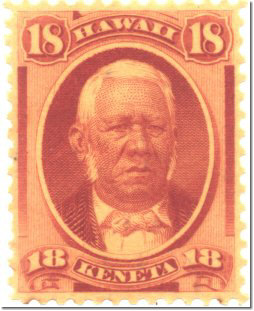
Mateo Kekuanaoa (1794-1868)
Son-in-law of Kamehameha I, companion of Kamehameha II,
and father of Kamehameha IV and V
Owning hundred year old stamps from the days when Hawaii was its own independent country, starting with the
days when it was ruled over by kings and queens is really, well, unreal. Stamps tell the story of transition,
from a monarchy, to an interim revolutionary government, to a republic, to a United States possession, and
finally to a Territory of the United States. Envelopes and letters tell of the people who lived there:
teachers, businessmen, public servants, and clerics, and of the people who stopped there on their travels –
whalemen, merchants, fur traders, hide traders, and world travelers. It is no wonder Hawaii has been one of
the most popular countries to collect since people began collecting stamps in the 1860's.
Here is what Mark Twain had to say in 1866 in Letters from the Sandwich Islands about Mateo Kekuanaoa,
whose portrait is on the postage stamp shown above, the 18¢ Scott Number 34, issued in 1874:
He is an erect, strongly built, massive featured, white-haired, swarthy old gentleman of about 80 years of
age or thereabouts. He was simply but well dressed, in a blue cloth coat and white vest, and white pantaloons,
without spot, dust or blemish upon them. He bears himself with a calm, stately dignity, and is a man of noble
presence. He was a young man and a distinguished warrior under that terrific old fighter, Kamehameha I, more
than half a century ago, and I could not help saying to myself, 'This man, naked as the day he was born, and
war-club and spear in hand, has charged at the head of savages against other hordes of savages, far back in
the past, and reveled in slaughter and carnage; has worshipped wooden images on his bended knees; has seen
hundreds of his race offered up in heathen temples as sacrifices to hideous idols, at a time when no
missionary's foot had ever pressed this soil, and he never heard of the white man's God; has believed his
enemy could secretly pray him to death; has seen the day, in his childhood, when it was a crime punishable by
death for a man to eat with his wife, or for a plebeian to let his shadow fall upon the King – and now look at
him: an educated Christian; neatly and handsomely dressed; a high minded elegant gentleman; a traveler, in
some degree, and one who has been the honored guest of royalty in Europe; a man practiced in holding the reins
of an enlightened government, and well versed in the politics of his country and in general, practical
information. Look at him, sitting there presiding over the deliberations of a legislative body, among whom
are white men – a grave, dignified, statesmanlike personage, and as seemingly natural and fitted to the place
as if he had been born in it and had never been out of it in his lifetime. Lord! how the experiences of this
old man's strange, eventful life must shame the cheap inventions of romance.
How do you start? An Oregon student named Brittany at Alliance Charter Academy recommends an article by Margery Stewart Baxter as a helpful way to begin. The article is on line at
Red Envelope. Here are some other tips:
1. Become acquainted with the stamps by going to your library. Find a copy
of Scott Specialized Catalogue of United States Stamps and Covers. Tucked away near the back of the
catalogue is a section devoted to United States Possessions. Here is where you will find the most
comprehensive and easily available catalogue of Hawaiian stamps. Although most Hawaiian stamps were issued
and used before Hawaii was a part of the United States, the collection of Hawaiian stamps has in modern times
been viewed by collectors as a sub-set of collecting United States stamps. If you prefer to own a copy of the
catalogue, you can purchase one on-line through one of the established postal literature dealers:
Leonard Hartmann and
James E. Lee.
2. You will find stamps valued from $1.00 to $660,000. Even if you are
someone with funds to buy the most expensive items, spend time studying the market and the stamps before
investing. For those seeking less expensive material, there are plenty of options, especially in the lower
value stamps printed in the 1880's and 1890's. Remember this, Scott Catalogue values are a reflection of
dealer prices for retail stamps in what is called "very fine" centering and faultless "condition" – more on
the terminology next. Prices are shown for unused and used specimens. A point to remember is this - stamps
of lesser quality cost far less than the prices given in the catalogue. If you are offered an off-center or
faulty stamp priced at full retail, pass on it.
3. If you are new to collecting stamps – or even if you have been collecting but
haven't yet done it, turn to the beginning of the Scott catalogue. There you will find how
catalogue prices are determined, definitions of "grade" and "condition" and illustrations of faults you will
want to recognize before purchasing. Mysterious terms such as – "perf", "imperf", "engr", "unwmk" – are
demystified in the opening pages of the catalogue. You will discover "grade" refers to how well a stamp image
is centered between the borders or perforations and you will see how grade will affect the price you should
pay. You will also discover "condition" – thin spots, tears, stains, holes and other faults - will affect
price. A general rule of thumb is to buy a stamp in the best grade and condition you can afford – well
centered and faultless, if it is in your budget. Set a budget for your stamp purchases so you keep balance in
your life.
4. Study the pages of Post Office in Paradise to learn more detail about each
of the stamp issues. At the "home" page or "Main Post Office", find the box entitled
"Site Map" located at the center of the page. Click there and the entire
table of contents for the site will open and you can go to any issue. Postage stamps are covered in the site
pages shown in the left hand column. Scott Catalogue groups stamps by the year of issue and
Post Office in Paradise groups stamps in chronological order by their popular collector names. If the
stamps of 1894-1899 interest you, scroll down the left column, click on "Pictorial
Issue" and you will find them. The 1893 stamps listed in Scott are listed in
Post Office in Paradise as the "Provisional Government Issue".
And so on. Most of the stamps shown in Scott with issue dates from 1864 to 1891 are listed in Post Office
in Paradise as the "Bank Note Issue" because Bank Note companies in New
York made them.
5. Where do you find stamps for sale? The days when retail stamp stores
populated our towns are gone. Today, most collectors use the Internet or travel to nearby "stamp shows".
Stamp shows feature dealer "bourses" – dealers pay a fee to the show organizer and set up tables where they
display their stocks of stamps. Don't be afraid to ask questions or look stupid. Most dealers are happy to
help. If you run into a grumpy one, move on. Stamp shows are advertised in local newspapers and sometimes
charge a small entry fee to help defray expenses. They are also listed in philatelic newspapers, such
as
Linn's Stamp News or by contacting
Mekeels & Stamps. The closer you are to a
metropolitan area, the better chance you will have of finding a local show nearby. Buying from Internet sites
is convenient, but all you get to see before you pay for a stamp is a picture of it. Still, I have never been
cheated on an Internet sale. On the few occasions when a stamp turned out to be different than as described,
the dealer took it back and refunded my payment. If an Internet seller is offering a $500 stamp for $1, you
should pass on it. You need to register to buy on an Internet site, but most sites will allow you to search
current listings without registering. Registration typically is an easy process. One popular Internet site
is
eBay. Find "Stamps" in the "Categories", click on "United States" and then click on "Possessions".
Another site to watch is
Zillions of Stamps. Find "Hawaii" in the country list and click on it to see what is offered by
participating dealers. If an item is listed without an image, ask the dealer to send you one. If you buy and
expensive stamp ("expensive" to you), tell the dealer you intend to submit the stamp for an expert certificate
so if it comes back "bad" – that is, not as described – you will have no trouble returning it for a refund.
Expert services are listed at Expert Services.
6. Join a local stamp club. I used
"Google", entered the name of the nearest big town and added "stamp club" to find information about
local clubs. In stamp clubs, you will find people passionate about stamp collecting and anxious to teach
useful lessons regardless of what you collect. If the first club you visit seems to lack what you want, try
another one.
7. Join the American Philatelic Society. Membership gives you access to
such things as its expert service, on-line stamp listings and other member benefits. You can join by
accessing
The American Philatelic Society.
8. Leave stamps on their envelopes and if stamps are on paper with the postmark or
cancel partially on the paper, leave the stamp on the paper. People collect postmarks and cancels
so if removing these stamps from their paper would destroy part of the postmark or cancel, you could lose
significant value. At Post Office in Paradise, postmarks, cancels and other markings are shown on
pages listed in the right-hand column of the Site Map.
9. How do I keep a stamp collection? Dry. Moisture will do more to
destroy your stamps than anything else – apart from carelessness in handling. Buy a pair of stamp tongs so
you avoid handling stamps with your fingers. Fingertips contain oil, as well as dirt. Also, buy a good
quality, acid free, stock book to house your stamps until you are ready to mount them in an album. When
mounting, use only hinges or mounts made for stamp collectors. Do not make your own mounts out of things like
Scotch Tape or glue. People in a local stamp club can help you with finding local outlets for supplies. One
company offering supplies is
Amos Advantage. Another is
Subway Stamp Shop. Get them on the phone, tell them you are a beginner and you want an acid free
stock book and a pair of stamp tongs. If you don't own a 10x (or higher) magnifying glass, also ask for one
of those. When you find a local stamp show you can attend, go there and ask to see albums. Get a dealer to
show you how to use stamp hinges and mounts. Album pages made specifically for Hawaii stamps are hard to find
in the marketplace today. Sometimes they are offered on-line at eBay. I personally prefer to design my own
arrangement from blank acid-free pages. Be careful about housing your stamps in plastic envelopes or cases
because cheap plastics can harm your stamps. Envelopes made from "glassine" are safer.
Remember this – stamp collecting is for your personal pleasure and for nobody else's.
Collect what you enjoy and have fun doing it. A pastime is supposed to relieve stress and let your mind focus
for a few hours on something other than compelling topics of the day. Collecting Hawaii will absorb your
attention, take you back to a romantic time when the Pacific Basin was the frontier of the world, and hold
your mind there until the pressures of the day eventually force themselves back into the fore – and when that
happens, your mind will be relaxed and solutions for all your worries will become obvious. Well, that's what
I was told once.
Is collecting Hawaii a good investment? If you collect very fine examples
in excellent condition and maintain them in proper fashion you should have value when you dispose of them.
Will your stamps be worth as much as you paid? Maybe and maybe not. You will only know when you dispose of
them. Meanwhile, they will give you joy and they will be worth more in your pocket than yesterday's movie.
 Back to