::: UPU Later Issues on Cover :::
|
|
 Back to Hawaiian Stamps on Foreign Mail.
|
ABNCo. Color Changes of NBNCo. Stamps
The ABNCo. made slight color changes to three NBNCo. stamps when it reprinted them,
essentially to fulfill philatelic sales.
March, 1886 Printing of the 1¢ Kamamalu in Purple
|
|
|
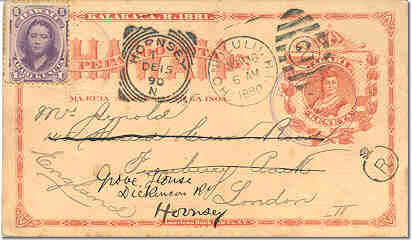
Postmarked November 16, 1890 at Honolulu and franked with a 1¢ purple, Scott No. 30, of
March, 1886, on a UX4 postal card. The crowned circle R is an English mark to indicate
the card was researched there to confirm it was sufficiently paid with valid stamps.
March, 1887 Printing of the 2¢ Kamehameha IV in Vermilion
|
|
|
Postmarked September 16, 1891 at Hamakuapoko and September 20 at Honolulu, this cover is
franked with the 2¢ vermilion Scott No. 31a in addition to the pair of 1¢ blue Scott
No. 37 on the 1¢ stamped envelope UPSS 3a.
October 10, 1891 Issue of the 5¢ Kamehameha V in Indigo Blue
|
|
|
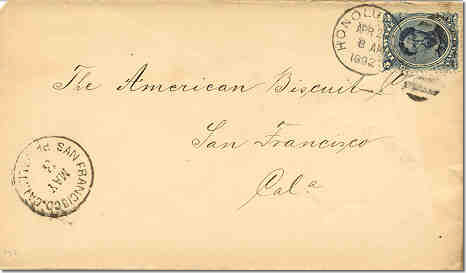
An order to reproduce the 5¢ Scott No. 32 brought instead Scott No. 52C, which made its
appearance on October 10, 1891. This Scott No. 52C cover is postmarked April 20, 1892.
November 7, 1891 Issue
One stamp was issued this date, the 2¢ dull violet Scott No. 52.
|
|
|
Postmarked November 16, 1897 and franked with, among others, the 2¢ Scott No. 52. This
philatelic cover is also franked with two of the old 5¢ Scott No. 32, a 1¢ blue Scott
No. 37 and singles of the 1¢ overprinted purple Scott No. 53 and green Scott No. 55 to
pay a triple letter rate. The 2¢ Scott No. 52 is seen commercially in foreign mail on
newspaper wrappings.
Provisional Government Issue
It is important to remember many of the overprinted stamps, first issued May 20, 1893,
were sold only in sets or full sheets to collectors who greeted the new issue with a
buying frenzy. See Provisional Government Issue
Seeing any but the comparatively common 1¢ Scott No. 55, 2¢ Scott No. 57, 2¢ Scott No.
66 or 5¢ Scott No. 59 on cover is a pretty sure (but not conclusive) sign of a
philatelic cover. See Philatelic Covers. The 5¢
ultramarine or combinations of Scott Nos. 55 and 57 are found on commercial covers.
The 5¢ indigo blue, Scott No. 58, or 10¢ red brown, Scott No. 68, are seen on a few
covers thought to be commercial in nature. Other stamps essentially were unavailable for
commercial use because collectors and dealers snapped them up as soon as they went on
sale.
|
|
|
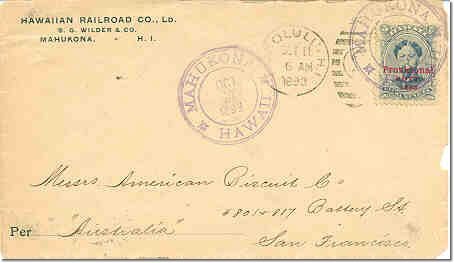
The 5¢ ultramarine Scott No. 59 is found on commercial covers in 1893 and 1894. This
cover postmarked at Honolulu on October 11, 1893 originated at Mahukona, Hawaii and was
postmarked there on October 10 with Mahukona type 282.011. The Hawaiian Railroad ran
through the sugar district of North Kohala and the port terminus was at arid and lightly
populated Mahukona.
|
|
|
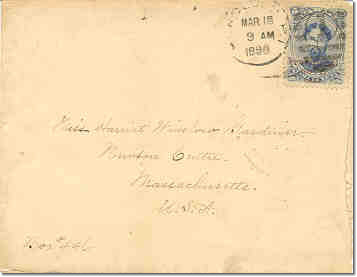
The 5¢ Scott No. 59 (die 1, re-entered) is found on covers in 1895 and 1896. This
example was postmarked at Honolulu on March 18, 1896.
|
|
|
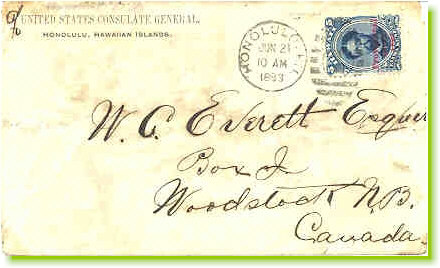
Here is a consular cover bearing the 5¢ indigo blue Scott No. 58. It is postmarked June
21, 1893 and could be a commercial use. A fresh printing of this stamp in June
replenished the supply after the initial stamps were sold out.
|
|
|
Combinations of Scott Nos. 55 and 57 are seen making up the 5¢ rate. This cover was
postmarked October 27, 1893 and was sent to Sydney, New South Wales.
|
|
|
Postmarked February 7, 1896 and franked with the 10¢ brown Scott No. 68 this commercial
cover was sent to San Francisco as a double weight cover. There were 2250 sheets of
this stamp printed and they were not all sold out at the post office so the stamp was
available for commercial use through 1896, after which the remainders were withdrawn and
burned.
|
|
|
A philatelic cover sent to Yokohama, Japan franked with the 10¢ Scott No. 67 and
postmarked July 18, 1893. Only 500 sheets of this stamp were printed and sold to
collectors and dealers. Notice the addressee is the same as on the next cover.
|
|
|
Another philatelic cover to the same addressee in Yokohama, this one franked with the 1¢
Scott No. 53, the 2¢ Scott No. 66 and the 12¢ black Scott No. 62. It is postmarked July
3, 1893. The 2¢ is comparatively common (250,000 stamps sold), but the 1¢ was were sold
out to collectors and dealers and the 12¢ adds a gross overpayment of the rate.
|
|
|
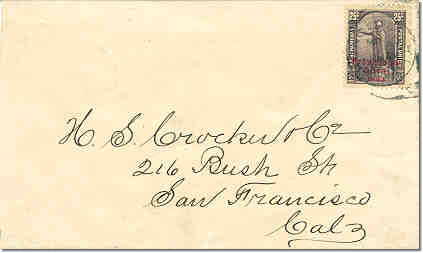
Postmarked May 23, 1893, three days after the Provisional Government overprinted stamps
went on sale, this philatelic cover is franked with the 25¢ Scott No. 64. Of this stamp,
the supply of 300 sheets was sold the first day to collectors.
Pictorial Issue
All of the stamps of the Pictorial, or Republic, Issue (See
Pictorial Issue) are
commonly found on commercial foreign mail covers with the exception of the 12¢ Scott No.
78 and the 25¢ Scott No. 79. Other than on a letter to Samoa or Fiji (I have none
recorded), there was no real use for the 12¢ stamp in the foreign mail except in
combination with other stamps. The 25¢ stamp is hard to find but does exist on
commercial covers as well as on philatelic covers.
|
|
|
Postmarked May 15, 1898 at Honolulu, this cover franked with the 1¢ Scott No. 74 and two
2¢ Scott No. 75 stamps originated at Kahului, Maui where it was postmarked May 14 with
Kahului type 272.642.
|
|
|
Franked with the 5¢ Scott No. 76, this cover originated at Laupahoehoe, Hawaii and was
postmarked there on September 1, 1899, with the unusual large postmark type 291.01, and
then postmarked at Honolulu on September 3.
|
|
|
Franked with the 10¢ Scott No. 77 to pay a double weight letter, this cover was
postmarked at Honolulu on February 9, 1899.
|
|
|
This philatelic registered cover postmarked March 3, 1898 is franked with, among others,
the 12¢ Scott No. 78 in combination to make up a 25¢ rate (10¢ registry fee and 15¢ for
a triple weight letter) to Carson City, Nevada. The normal size envelope shows no sign
of enclosing a triple weight letter.
|
|
|
This registered cover is franked with the 25¢ Scott No. 79 and the 5¢ Scott
No. 76 and postmarked December 13, 1894. The rate is 10¢ registry fee, 5¢ return
receipt and 15¢ for a triple weight letter. This large envelope could have enclosed a
triple weight letter.
|
|
|
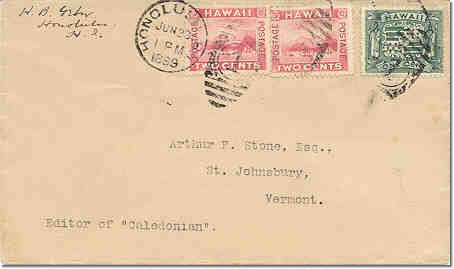
Postmarked June 23, 1899 and franked with the 1¢ Scott No. 80 and two 2¢ Scott No. 81
(the right stamp No. 81 having the flying goose flaw) for the 5¢ rate.
|
|
|
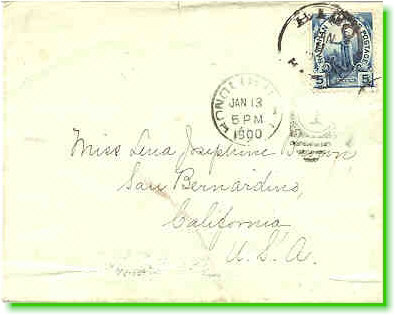
This cover originated at Hilo, Hawaii where it was postmarked January 11, 1900 with
postmark type 253.03 and at Honolulu on January 13.
|
|
Back to Hawaiian Stamps on Foreign Mail.
|
|

|
|
Copyright © 1999 - 2004 POST OFFICE IN PARADISE. All rights reserved.
|