::: UPU Philatelic Covers :::
|
|
 Back to UPU Period.
|
Whether one chooses to collect philatelic covers is a matter of personal taste, but it
is important to recognize world stamp collectors at the end of the 19th Century put
Hawaii at the top of the list of favorite countries to collect and kept it there
throughout the 1890's and into the first decade of the 20th Century. Interest in
collecting Hawaii was so intense stamps were being stolen from covers in transit.
Covers addressed to virtually every notable stamp dealer in the world can be found in
this Period. For me, philatelic covers represent the zenith of philatelic interest in
Hawaii and make an interesting topical collection.
Several things about a cover may suggest - or even proclaim - it is a philatelic cover.
One important factor is whether it pays a real rate. If it grossly overpays any
reasonable rate interpretation, it must be considered philatelic. Another sign is
whether the combination of stamps is contrived, even if it appears to pay a reasonable
rate. Some covers are franked with overprinted stamps sold at the Honolulu post office
only in sets to collectors or dealers' agents. Covers bearing these stamps must be
considered philatelic. Even normal covers can fall under the heading of philatelic if
the addressee or sender is a recognized stamp dealer or collector. Certain values if
found on cover in this period will give away the philatelic character of a cover. The
25¢ stamp is the highest value I have seen on a commercial cover. There are 18¢ stamps
on commercial covers from the Convention Period, but from the UPU Period the 18¢ covers
I have seen are philatelic. In this Period, we see 12¢ covers in the Australasian Mail
during the UPU Period but most other 12¢ covers in the UPU Period are philatelic.
Registered mail offered a means to create philatelic covers for high value stamps with
less risk of having them stolen from the cover while in transit so a relatively high
percentage of philatelic covers are registered covers.
Pricing philatelic covers is a challenge for collectors and dealers alike. Combinations
of stamps on philatelic covers are too varied for traditional price catalogues to
include. Results of recent auction sales of philatelic covers offer some clues to how
these covers can or should get priced. See the discussion following the prices realized
from a recent Siegel auction at Auction News Archive.
|
|
|
This cover was ordered by a collector in Germany who specified (by written instruction
hidden by the stamps) it was to be franked with
two 18¢ stamps and registered. It is postmarked February 6, 1890. There was no 36¢
rate for registered mail. Conceivably the cover cost 35¢ (20¢ for a double weight letter,
10¢ for the registry fee and 5¢ for a return receipt.)
|
|
|
|
|
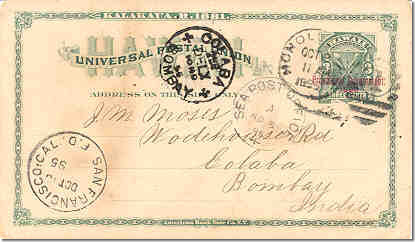
A pair of covers, one the fairly common postal card UX4 (top image), franked with an
added ordinary 1¢ green overprinted stamp, Scott No. 55, and the other the uncommon 3¢ UX7
(bottom image). A 2¢ UX6 is known to fill in the complete set. All three are addressed
to the same addressee at Bombay, India, postmarked on October 2, 1895, and sent via San
Francisco to Bombay, picking up the Bombay Sea Post Office mark. The postal card rate
to India at the time was 2¢.
|
|
|
This combination of stamps to pay a 25¢ rate is contrived. It was postmarked at
Honolulu on August 14, 1893. Only 20,000 of the 15¢ stamps were overprinted so it must
be considered scarce, considering the demand from collectors, dealers and speculators.
The cover could have been franked with the more common 10¢ brown (100,000 printed by the
time this cover was sent) or five of the ordinary 5¢ ultramarine Scott No. 59. Based on
the combination of stamps, I suspect the cover was sent to a collector.
|
|
|
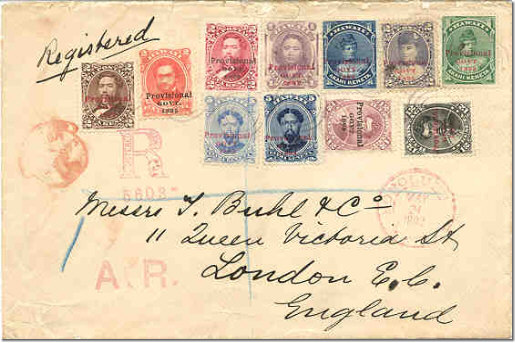
This philatelic cover is franked with a wonderful variety of overprinted stamps, some
commonly found on commercial covers and others found only on philatelic covers. The
Honolulu Post Office sold such stamps as Scott No. 56, 58, 65 and 69 only in sets or in
complete sheets for collectors. This registered cover was postmarked at Honolulu on May
24, 1893, just four days after the overprinted stamps went on sale.
|
|
|
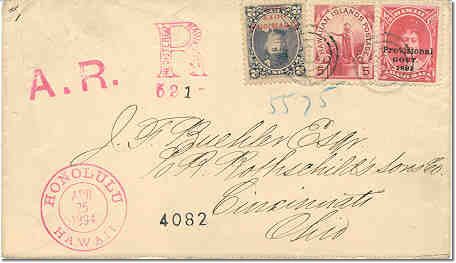
Postmarked April 25, 1894 and franked with the 2¢ Scott No. 57, 5¢ Scott No. 74 and $1
Scott No. 73 shows a philatelic use for the $1 stamp. The other two stamps are commonly
found on commercial covers.
|
|
|
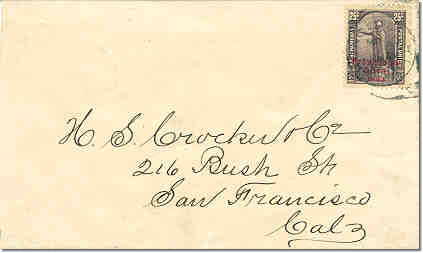
Postmarked May 23, 1893, three days after the overprinted stamps went on sale, this
cover is certainly philatelic. The 25¢ stamps were sold out to collectors and the cover
just does not seem to be a quintuple rate cover.
|
|
|
Here we have a complex arrangement of Bank Note stamps, including two left over 5¢ Scott
No. 32 stamps, and overprinted stamps. The sender wrote "Registered" on it, but failed
to get it registered. It is postmarked On November 16, 1897. The last day of sale for
remainders of the overprinted stamps was December 31, 1896 and the remainders left in
stock were destroyed in January, 1897. This cover thus is franked entirely with
obsolete stamps, still valid for postage. Also interesting is the absence of any
transit or receiving mark. One must therefore wonder whether it went anywhere or
whether it was canceled and handed back to a collector.
|
|
|
Another contrived combination of stamps is seen on this registered cover postmarked at
Honolulu on May 9, 1900. If the cover genuinely required 50¢ in postage, then two of
the 25¢ stamps would have been simpler.
Covers To or From Identified Stamp Dealers
Presumably all philatelic covers had a collector at one end or the other of the
transmission. Cases are documented where collectors put philatelic covers into the mail
with instructions to the recipient to place them in a larger envelope and return them so
the collector would have a nice cover. Of special interest to me are those covers sent
to or from stamp dealers or publishers I can identify. Some covers to dealers are
commercial and they are philatelic only because of the presumed nature of the business
being conducted by mail.
|
|
|
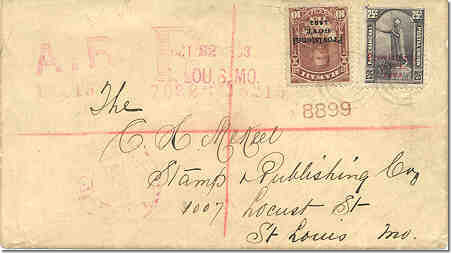
Postmarked October 11, 1893 and franked with the overprinted 10¢ brown Scott No. 68 and
the 25¢ Scott No. 64 and addressed the C. H. Mekeel, one of the founders of Mekeel's
Stamps.
|
|
|
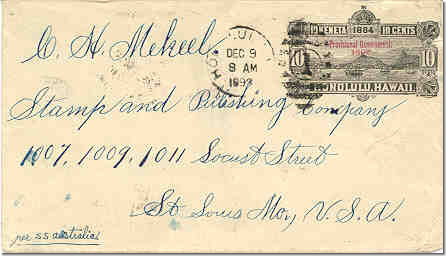
Another cover sent to Mekeel, this one on the UPSS 20 stamped envelope. The only
philatelic part of this cover is the addressee.
|
|
|
A registered cover sent to a well known pioneer stamp dealer in San Francisco and
franked with the overprinted 18¢ Scott No. 71 as well as the 5¢ and 10¢ Republic Issue
stamps. This cover originated at Waimea, Kauai and was postmarked at Honolulu on
December 4, 1895. A 53¢ rate cannot be reconciled with normal rates. The registry fee
with return receipt cost 15¢ and leaves 38¢ to explain. At letter rates, the letter is
overpaid by 3¢. At the book or other matter rate, it must have weighed 4¾ pounds, but
12 ounces was the maximum allowed. The sender, Mr. Blacksted of Waimea, Kauai, originated
an extensive correspondence, some commercial but many philatelic.
|
|
|
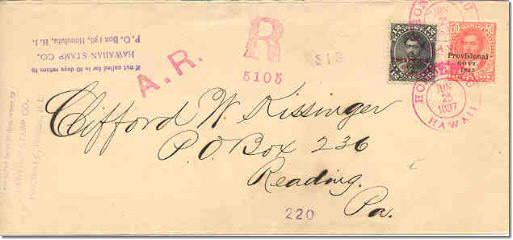
Postmarked June 25, 1897 this registered letter is franked with the overprinted 12¢
Scott No. 63 and the 50¢ Scott No. 72 for a 62¢ phantom rate (47¢ for letter postage
after deducting the 15¢ charged for a registered return receipt letter. This cover
was sent by the Hawaiian Stamp Company and bears its handstamped advertising corner
card.
|
|
|
Still another cover from the Hawaiian Stamp Company, this one franked with Scott Nos.
70 and 71 for an unheard of 33¢ rate (anticipating by 100 years the current United States first class rate).
This cover was postmarked April 24, 1894 at Honolulu. A registered single weight
letter cost 20¢ at that time. This cover is large, so make it a triple weight letter
and still it only cost 30¢. Both of these stamps were sold out to speculators,
collectors and dealers when the stamps first went on sale but an additional supply of
18¢ stamps was printed late in 1893. Still, finding either of these stamps on cover
is a pretty sure sign the cover is philatelic.
|
|
|
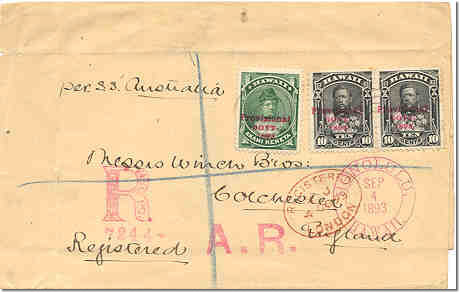
Postmarked at Honolulu on September 4, 1893, this cover is one of several sent in a
tight time frame using the retired postmark device, type 273.01, and addressed to the
Winch Brothers. The black 10¢ stamps were overprinted in a small supply of 37,500,
although more were printed late in 1893, after this cover was sent. Finding it on
cover suggests the cover is philatelic, but the case is strengthened for this cover
because of other covers to the same addressee at the same time.
|
|
|
E. W. Holdsworth sent this cover to Whitfield King, stamp dealers in England. The
boxed REGISTERED appears only on covers he prepared so it is thought to be a private
marking. This cover is postmarked at Honolulu on September 6, 1893 and is signed on
the back by Holbrook who was an active collector and winner of the contest to design
the Pictorial Issue stamps.
|
|
|
A commercial cover, but sent to the Scott Stamp & Coin Co., so it gets a philatelic
label because of the addressee. It is postmarked April 30, 1893.
|
|
|
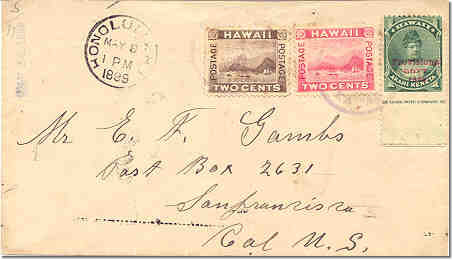
E. F. Gambs was an active dealer in Hawaiian stamps in San Francisco in the 1890's.
This combination of stamps looks contrived as well so the philatelic classification for
this cover rests on more than just the identity of the addressee.
BIBLIOGRAPHY
Sharbaugh, A. Harry, "Hawaii's White Elephants, Those 6¢, 12¢ and 18¢ Stamps",
Po'Oleka O Hawaii, No. 32, p. 1-11, July, 1983. Focus is on distinction between
"natural" uses and "philatelic" uses of Scott Nos. 33, 34, 36, 46 and 78.
|
|
Back to UPU Period.
|
|

|
|
Copyright © 1999 - 2004 POST OFFICE IN PARADISE. All rights reserved.
|
|