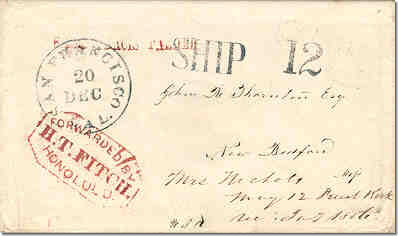
This cover bears two Auxiliary Marks, one a ship mark for the Bark Francis
Palmer and the other a forwarder mark of H. T. Fitch in Honolulu.
Auxiliary Marks include a wide variety of marks
associated in some way with mail but not applied by the Hawaiian Postal Service. This
page addresses the various ship marks,
railway marks,
forwarder's marks,
express company marks,
merchant marks,
government office marks,
plantation or ranch marks,
religious orders and
consular offices showing how mail was handled. The
number of marks encompassed by the Auxiliary Marks is extensive and some are unique.
Look on other pages for:
-->
Most marks used by the Hawaiian Postal Service. Those marks are described in
Honolulu Postmarks,
Town Postmarks,
Service Marks and
Cancels. However, handstamps used to designate
official post office mail are illustrated here under the heading Official Marks.
-->
Marks used by the New Zealand Marine Post Office (the NZMPO) and Paquebot marks applied in
other countries to mail bearing Hawaiian postage stamps. Those marks are catalogued in
NZMPO and Paquebot Marks.
-->
Postal marks applied by foreign exchange offices. Those marks are included in
Foreign Postal Markings.
-->
Fiscal marks on postage stamps, covered in
Fiscal Cancels on Scott No. 49.
In the Davey/Bash listings published as Part III of Meyer and Harris, Auxiliary Marks
are placed in Sections seven through thirteen. Davey/Bash used a simple numbering
sequence to identify auxiliary marks. They assigned numbers 351 through 662 to
auxiliary marks. Auxiliary marks lend themselves fairly well to a descriptive
identification system and therefore one is offered here. Your feed back will be
appreciated.
Auxiliary Marks covered on these pages fall into the following classifications:
 Transportation Marks: this category includes all
of the ship marks
(Davey Section 7), including manuscript marks, and
railroad marks
(Davey Section 9). Many covers bear ship names but
only those marks identifying a vessel intended to carry the letter (for either
inter-island or foreign shipping) are considered Auxiliary Marks. Other ship names
included in the address or written to show where the letter originated are not included.
Also part of this group are other marks associated with the carriage of mail by sea or
by rail. Click here to view Transportation Marks.
Transportation Marks: this category includes all
of the ship marks
(Davey Section 7), including manuscript marks, and
railroad marks
(Davey Section 9). Many covers bear ship names but
only those marks identifying a vessel intended to carry the letter (for either
inter-island or foreign shipping) are considered Auxiliary Marks. Other ship names
included in the address or written to show where the letter originated are not included.
Also part of this group are other marks associated with the carriage of mail by sea or
by rail. Click here to view Transportation Marks.
Forwarder Agent Marks: forwarders and express
companies performed different services. Nonetheless, most authors lumped them together.
Davey treated them
together in his Section 13. A
forwarder was a private establishment of some sort
that assumed responsibility to accept letters and place them aboard a suitable vessel.
An express company would take responsibility both
to send the letter on its way and to deliver the letter over at least part of the route. I separate the two marks for
our study. Click here to view Forwarder Agent Marks.
Express Company Marks: two express companies with
offices in Honolulu used marks and they are set out on this page. These marks were
included in Davey's Section 13. Click here to view
Express Company Marks.
Official Marks: various government offices used
handstamps, manuscript notations, seals or labels. Postal markings have been
restricted to handstamps or manuscripts in the other sections. However, this group
includes handstamps, manuscripts, seals and labels. Also included here are marks used
by Hawaiian offices located abroad or foreign government offices situated in Hawaii.
Of this group, Davey included only the Foreign
Office handstamp (his Section 10). Click here to
view Official Marks.
Private Sender Marks: used by
private businesses,
religious and other
charitable organizations,
plantations,
ranches and
individuals form a large and interesting group of
handstamps or letterpress marks. Any handstamp or seal used by a private person or
organization to indicate the sender would
qualify. These marks and seals were largely ignored by Davey and other writers.
Davey's Section 12 lists a few of these marks under
the heading "Private Company Marks." Some of these marks could prove to be town
postmarks but emanate from places with no listed post office. Others might have been
used to indicate a forwarding service but lack the word "forwarded." Most of these
marks merely show where the letter originated in the nature of a return address.
Click here to view Private Sender Marks.
Foreign Auxiliary Marks: a few foreign auxiliary
marks are found on mail to or from Hawaii. Davey did not address these marks in his
list. Forwarders in San Francisco or elsewhere are particularly interesting and are
included on various pages in this site. Some ship marks included
under Transportation Marks probably were applied
in a foreign country but they nonetheless are grouped with the other ship marks. On
this page you will find additional foreign forwarders and express marks, including the
San Francisco forwarder and express company marks. Click here to view
Foreign Auxiliary Marks.
The remaining two Davey sections (8 and 11) dealing
with Auxiliary Marks are addressed on other pages, as mentioned above: his section
eight, port of arrival markings, is covered at Foreign Postal Markings
and his section eleven, fiscal markings on postage stamps, is addressed at
Fiscal Cancels on Scott No. 49.