::: DOMESTIC COVERS :::
|
|
|
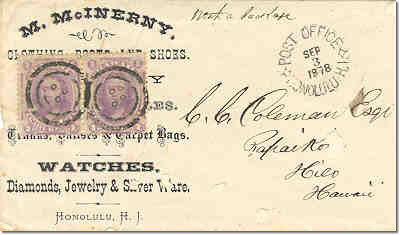
Advertising cover for M. McInerny, clothiers, Honolulu, postmarked at Honolulu on
September 3, 1878 with type 223.029, and sent to Papaikou, a town located in the Hilo
District on the island of Hawaii. This cover is franked with a pair of 1¢ mauve stamps
picturing Princess Victoria Kamamalu, Scott No. 30a, tied with the patent cancel, MH type 116.
Covers sent in the domestic mail before August 1,
1859, were free and bore no stamps. With the imposition of a 2¢ postage rate starting
August 1, 1859, also came a prohibition on carrying unstamped letters from place to
place so all covers were required to be stamped. Covers bearing Hawaiian stamps in the
domestic mail make interesting study. Some collectors seek an example of each
stamp on cover. Other areas of interest to
collectors are advertising covers or
philatelic covers. Finally, collectors of the
postal or auxiliary markings look for examples of
these markings on a full cover. The purpose of this page is to show these various
interests in domestic mail covers. Covers sent in the foreign mail are shown in
Foreign Mails and Covers. Covers can sometimes
provide important evidence of domestic mail routes and those covers are studied in
Routes & Post Offices. Covers illustrating domestic
rates are featured in Rates.
PRE-STAMP PERIOD
One can go all the way back to the early days of European contact to find examples of
written communications sent from one place to another in the islands. With the arrival
of missionary families in 1820, domestic correspondence increased. Letters passing
among the missionary families were carried by friends as occasions arose. When the
Honolulu post office was established late in 1850, there was no immediate effect on
handling domestic letters because the Honolulu post office at first was interested
primarily in mail to or from foreign destinations. After several failed efforts, mail
routes were organized around the islands in 1856, but it was still unreliable and people
preferred to send their letters privately. In any event, no fee was charged to carry a
letter in the government mail bag. The pre-stamp period ended August 1, 1859, when the
law compelling pre-payment of postage on all letters carried from place to place
(regardless of whether carried privately or in the mail) also made it unlawful to carry
unstamped letters.
Pre-stamp covers usually were folded letters so the contents are still available to read.
From an historians point of view, the pre-stamp covers contain potentially useful or
interesting facts or anecdotes about life in Hawaii in the early years of Western
settlement. Philatelists typically pay little notice to the pre-stamp covers because
there are no postal markings or stamps to catch the eye of most stamp collectors.
|
|
|
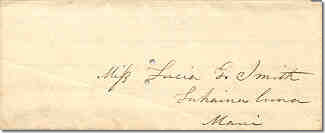
Letter dated October 24, 1837, at Honolulu, from Lorraine Castle, wife of Samuel Castle
- later a founder of Castle & Cooke, to Lucia Smith - later to be the wife of Rev.
Lorenzo Lyons.
|
|
|
Letter dated August 7, 1848 from Edwin O. Hall - who became editor of The Polynesian in
1849, to Rev. Dwight Baldwin. The letter describes trouble in finding ships because
most had gone to California. Hall also describes receipt of news from Mazatlan.
STAMPS ON DOMESTIC MAIL COVERS
With the exception of letters sent under the free
franking privilege or letters sent without stamps because a post office had run out of
its supply, all covers sent in the domestic mail from August 1, 1859, to the end of
Hawaii's postal period on June 14, 1900, were franked with Hawaiian postage stamps.
For a detailed analysis of the domestic postage rates and covers showing those rates,
see Rates. The primary rate for domestic mail was 2¢
for a single letter. Use of the 1¢ stamp was for drop letters, transient newspapers and
circulars.
Stamps produced for domestic mail in these denominations begin with the Numeral Issue.
Numerals on cover are scarce at best and downright rare except for the 2¢ Scott No. 16.
Almost as scarce are covers bearing the 2¢ Boston Lithographed laid paper stamps. Once
we reach the Bank Note issue, covers bearing the various 2¢ stamps become more common,
with the exception of two, Scott No. 38 and No. 43a. Both of these stamps are scarce on
cover. None of the 1¢ Bank Note stamps is common on cover - all are scarce or rare.
Finding a higher value Bank Note stamp on a domestic cover is really tough. Except the
6¢ value, I have no record of higher value Bank Note stamps on domestic covers. In the
overprinted issue of 1893, both the 1¢ and 2¢ values can be found because of the high
incidence of philatelic covers. Among the overprints, some issues are found only on
philatelic covers, although some philatelic covers seem ordinary. The only stamp
commonly found on commercial domestic mail is the 2¢ Scott No. 57. Once we arrive at
the Republic Issue stamps, it is easy to find either the 1¢ or the 2¢ stamps on cover.
For examples of Hawaiian stamps on foreign covers see the various sections under
Foreign Mail and Covers.
NUMERAL ISSUE STAMPS ON DOMESTIC COVERS
One cent and two cents stamps of the Numeral Issue are found on domestic covers. The 5¢
values in the Numeral Issue were for foreign mail use. Two cent stamps from the various
plates constituting Scott No. 16 (Westerberg Plates 3-C to 3-G) are scarce on cover.
All of the other one cent and two cent numerals are genuinely rare on cover. For a
discussion of the Numeral Stamps themselves, see Numeral Issue.
|
|
|
Scott No. 16, Plate 3-C-VI, on an outer sheet postmarked December 24, (c.1862), at
Lahaina, Maui, with a greenish blue postmark type 243.02, first used in August, 1862.
The Catholic Mission in Hawaii commonly used outer sheets as homemade envelopes, rather
than commercial envelopes.
|
|
|
Scott No. 16, Plate 3-E-I, on a cover docketed September 4, 1860, about a year after the
domestic postage rate of 2¢ went into effect. This particular stamp is illustrated on
page 41 of Westerberg's plating study.
|
|
|
Scott No. 16, Plate 3-G-VII, on a folded letter sheet from Kapaa, Kauai dated March __,
1864, and written in the native Hawaiian language. It is marked with the early Postage
Paid oval service mark.
BOSTON LITHOGRAPH ISSUE STAMPS ON DOMESTIC COVERS
Four Scott Catalogue numbers, Scott Nos. 27, 27a, 28 and 28a, comprise this issue. The
first of these stamps appeared in 1861 and were used until about 1864 when the supply
ran out. For a detailed discussion of the stamps themselves, see
Boston Lithograph Issue. Stamps of this issue are scarce on cover.
|
|
|
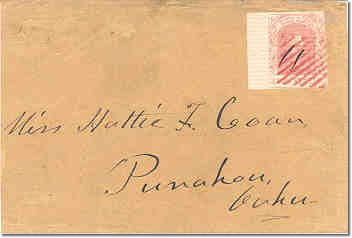
Scott No. 27 on cover from Hilo to Punahou on Oahu. It is undated but the red grid
probably was changed to black in mid-1863.
 Click here for more images of the Boston Lithograph Issue On Cover.
BANK NOTE ISSUE STAMPS ON DOMESTIC COVERS
One cent and two cent stamps of the Bank Note Issue were intended for domestic mail.
It is somewhat strange that Hawaii never had a 4¢ stamp to pay for a double rated
domestic letter. Stamps with values of 5¢ and higher were made primarily for foreign
mail, but the 6¢ value lent itself to pay triple rated covers and other domestic rates.
For more information about the Bank Note Issue stamps, see Bank Note Issue.
THE TWO CENT BANK NOTES
Stamps of the 2¢ value begin with Scott No. 31, in
1864. This stamp served Hawaii until 1875, when the 2¢ Kalakaua
Scott No. 35 was introduced. In 1882, the color of
the Kalakaua stamp was changed and we have the lilac
Scott No. 38. Another color change in 1883 produced
the dull red Scott No. 43a, and then in 1884 with
the carmine colored Scott No. 43. In March, 1887,
the old design of Scott No. 31 was printed in a new color, vermilion, and is given
Scott No. 31a. The final 2¢ stamp of this issue was
the Liliuokalani violet colored Scott No. 52 issued
in 1891.
Click here for images of the 2¢ Bank Note Stamps On Cover.
THE ONE CENT BANK NOTES
Unlike the 2¢ stamps, all of the 1¢ Bank Note stamps are scarce at best on cover. First in this
group was the mauve colored 1¢ Kamamalu, Scott No. 30a,
issued in March, 1871. Only a handful of covers, one at the top of this page, exist
with this stamp. The same design was used in 1876 to produce a new color, the 1¢
Kamamalu violet, Scott No. 30b and is another rare
stamp on cover. In March, 1882, the 1¢ blue Likelike,
Scott No. 37 appeared, quickly followed in June of
the same year by a color change to green, Scott No. 42. Together, these two
stamps served the need for 1¢ stamps until the overprinting in 1893. The blue color
stamp is rare on a commercial domestic cover. The green color stamp is only slightly
more available on cover. The old design of the Kamamalu stamp was reprinted
in purple in 1886, Scott No. 30.
Click here for images of the 1¢ Bank Note Stamps On Cover.
HIGHER VALUE BANK NOTE STAMPS
The only higher value Bank Note Issue stamp I record on domestic commercial mail is the
6¢ value, issued in March, 1871, Scott No. 33.
This stamp was intended primarily to pay the new 6¢ Convention Period rate on foreign
mail. It is scarce on covers in the domestic mail:
|
|
|
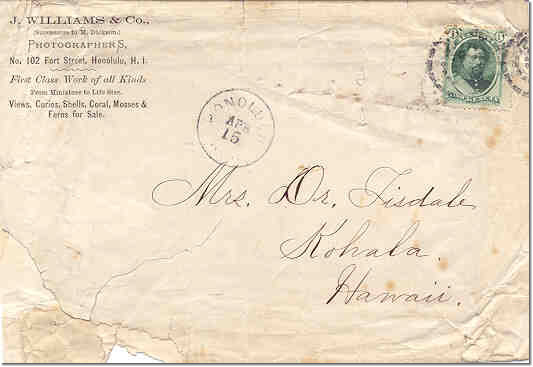
Dated April 15, year uncertain but probably in the late 1870's, this cover bears the 6¢
Scott No. 33 to pay the domestic third class rate. The only other higher value Bank
Note Issue stamps I have noted in domestic mail are philatelic covers.
OVERPRINTED STAMPS OF THE PROVISIONAL GOVERNMENT
When the Provisional Government ordered stamps overprinted in 1893, all of the 1¢ and 2¢
Bank Note Issue stamps were available except the 1¢ violet, Scott No. 30b and the 2¢
lilac and 2¢ dull red, Scott Nos. 38 and 43a. For a detailed discussion of the
overprinted stamps, see Provisional Government Issue.
Distinguishing commercial covers from philatelic inspirations in these stamps is often
difficult. Only one overprinted stamp is found commonly on domestic commercial covers,
the 2¢ Liliuokalani, Scott No. 57.
Click here for images of the Overprinted Provisional Government Stamps On Cover.
PICTORIAL ISSUE STAMPS ON DOMESTIC COVERS
Four stamps make up the 1¢ and 2¢ values of this Issue. The 1¢ coat of arms was first
printed in yellow in 1894, Scott No. 74 and in green
in 1899, Scott No. 80. The 2¢ Diamond Head was
first printed in brown in 1894, Scott No. 75, and
in a salmon red in 1899, Scott No. 81. These stamps
are commonly found on commercial domestic covers. The higher value 10¢ is noted used
in domestic mail for the registered mail rate. Other higher value stamps found on
domestic covers are considered philatelic. For detailed discussion of these stamps, see
Pictorial Issue.
Click here for images of the Pictorial Issue Stamps On Cover.
STAMPLESS DOMESTIC COVERS
|
|
|
This stampless letter was mailed from Hoopuloa, Hawaii on February 21, 1899 and
postmarked with Hoopuloa type 282.011. That town was known for running out of stamps.
Very few stampless non-official covers exist after
August 1, 1859. The law made it illegal for anyone to carry an unstamped letter from
one place to another. Exceptions were consignee letters and letters mailed from a post
office without stamps. Other examples of stampless domestic covers, including the
postmaster provisional covers, are shown at Domestic Rates.
DOMESTIC POSTAL CARDS
Postal cards of 1¢ value were issued for domestic
mail, starting in 1882 with UX1. The 2¢ black,
UX2 was also issued that year. When country post offices ordered too many of
the 2¢ or 3¢ cards, the central post office refused to redeem them. Local postmasters cut
their losses by selling them for 1¢ to be used in domestic mail so the UX2 and UX3 are also found
in domestic mail. In 1892, the 1¢ postal card was re-issued in a buff color,
UX4 and these cards were overprinted by the
Provisional Government in 1893, UX5. The Republic
of Hawaii issued a new 1¢ card, UX8 in 1894 and
re-issued it in a slightly different size and color in 1897,
UX8a. All of these cards are fairly plentiful,
with only UX4 and
UX5 being a little difficult to find used in
domestic mail. For details on the postal cards, see Postal Cards.
Click here for images of Used Domestic Mail Postal Cards.
POSTAL STATIONERY IN DOMESTIC MAIL
Three values of postal stationery are found on
commercial domestic covers. The different values, sizes and thicknesses and issue
dates of the postal stationery are discussed at
Postal Stationery. The values printed for
domestic mail were the 1¢ green UPSS 1 to 3a, the
2¢ red or carmine UPSS 4 to 6a and the 4¢ vermilion
UPSS 7. Of these envelopes, the 1¢ UPSS 3 is rare
used – indeed it is unrecorded used. The 2¢ pale pink UPSS 6 is scarce used. Blue
inside envelopes of the 2¢ and 4¢ values are UPSS 12 and 13.
These envelopes are rare used. Higher value envelopes are found in domestic mail as
philatelic uses. Some of the 1¢ and 2¢ envelopes were overprinted in 1893,
UPSS 16-17. These envelopes are harder to find used.
Click here for images of Used Domestic Postal Stationery.
ADVERTISING COVERS
|
|
|
A printed corner card for the United States Consular Agent at Hilo, mailed from Hilo,
is one example of an advertising cover.
Advertising covers made their appearance in
Hawaiian domestic mail during the 1870's. Another example is shown at the top of this
page. During the 1890's a rich and interesting array of advertising covers are found
in the domestic mail. Covers bearing advertisements will command a considerably higher
value in the market place. For advertising covers in the foreign mail, see
Advertising Covers in the UPU Period.
Click here for images of Local Mail Advertising Covers.
PHILATELIC COVERS
During the 1890's the frenzy for Hawaiian stamps
inspired many philatelic covers. For those collectors who desire the purity of
commercial covers, some domestic covers create problems because they appear at first
glance to be commercial covers but can be shown to be philatelic. Addressees can give
away the philatelic nature of a cover. Another clue is the appearance on cover of a
stamp sold only in sets at the post office. Many of the overprinted stamps fall into
this category. An overprinted 2¢ Scott No. 65 on cover, for example, is certainly
philatelic because it was issued in a small quantity and only in a set to collectors.
Click here for images of Philatelic Covers.
|
|

|
|
Copyright © 1999 - 2014 POST OFFICE IN PARADISE. All rights reserved.
|
|