::: POSTAL ENVELOPES :::
|
|
|
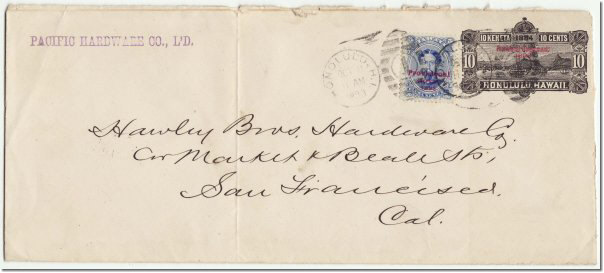
A 10¢ stamped postal envelope mailed to San Francisco on October 11, 1893, also franked with a 5¢ ultramarine
postage stamp overprinted Provisional/Govt./1893. This envelope was among the regular postal envelopes overprinted
by the Hawaiian Postal Service on August 28, 1893, to reflect the
change of government, and is the earliest documented use of PS-44.
|
|
OVERVIEW
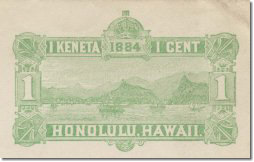
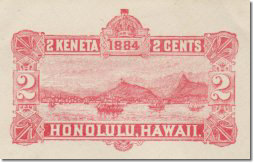
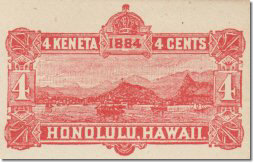
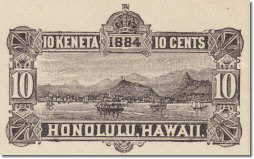
Hawaii introduced postal stamped envelopes in 1884, ordered through the American Bank Note Company in New York City. Five values
were produced: 1¢, 2¢, 4¢, 5¢ and 10¢. These values were intended to pay the following letter rates: 1¢ for the domestic drop letter
rate for delivery at the post office where mailed; 2¢ for the regular domestic rate on a single weight first class letter carried beyond the
post office where mailed; 4¢ for a double weight domestic letter; 5¢ for a single weight letter to North America; 10¢ for a single weight
letter to Europe and other distant destinations, or a double rate to North America. Later printings were made of the 1¢ and 2¢ values
until 1892. In 1893, the rate for a single weight letter to Europe was reduced to 5¢ (see
Mail Rates/UPU Period Rates). After Queen Liliuokalani was deposed on January 17, 1893,
and a Provisional Government was installed, the envelopes on hand at that time were overprinted to reflect the change in government.
None of the 4¢ envelopes remained in stock, but envelopes for each of the other values were overprinted.
The five values of stamped envelopes used in Hawaii:
|
|
|
|
|
The first order for postal envelopes (1883) specified three sizes of envelope and various qualities of paper. The three sizes were numbered 5, 6, and 10. Note: Until 2009, the large size envelope used for printing some of the 10¢ value were always designated #10. In the 1883 order sent to the American Bank Note Company, PMG Whitney, a printer by trade, used #10 to specify the size desired and the American Bank Note Company knew what a #10 size envelope was. In the bibliography below, including in the editions of the USPPS catalogue before the 2009 edition, “10” is used to designate the large size envelope. However, in the 2009 edition of the USPPS United States Possessions catalogue (the 2nd entry in the bibliography), the editor changed the numerical reference for the Hawaii large envelopes from #10 to #23, apparently to conform to a change made earlier in catalogues for other areas. Rather than resist this change and risk confusion, #23 is used here to refer to the large envelope previously referred to as #10.
The small and medium sized envelopes were designated Size 5 and Size 6.
Three qualities were specified, based on differing weights per 1,000 envelopes. Today, collectors typically distinguish these quality
differences by reference to comparative thicknesses of the envelope paper. Lighter weight (thinner) envelopes were expressed as "X" in
the order, medium weight (medium thickness) envelopes expressed as "XX", and heavier weight (thicker) envelopes expressed as "XXX".
In all, twenty-four envelope varieties scattered among the five values were produced in response to the first order.
While the paper laid flat before folding, envelopes were cut to shape using a cutting "knife". Each cutting knife created a distinct shape to the back flaps. Five distinct "knives"
have been identified, labeled P-9, P-10, P-11a, P-11b, and P-12. The knife used to make the size 5 envelopes is called knife P-9. Size 6 envelopes delivered in 1884 and 1885 were cut with
knife P-10, having widely rounded back-flap tips. For the January, 1889, order of 1¢ and 2¢ size 6 envelopes, knife P-11a was used. This knife produced slightly rounded, but nearly pointed, back-flap tips. Later orders of the 1¢ and 2¢ size 6 envelopes were cut with knife P-11b, having a slightly more pointed tip than knife P-11a. The size 23 envelopes were cut with knife 12.
The 1885 and later orders for 1¢ and 2¢ envelopes came in new colors, and wear became apparent in the die used for the 1¢ value.
These changes all added to the number of envelope varieties. Scott Catalogue has never revamped its listing since the days when
collectors were interested primarily in cut squares. Thus, Scott Catalogue ignores differences in size, knife, or paper thickness and
concentrates only on color and denomination. Also, the Scott catalogue color references are poor guides.
Students of Hawaii postal stationery usually prefer the more detailed catalog of the United Postal Stationery Society (UPSS), identified in
the bibliography at the end of this page. The UPSS catalog includes the Hawaii Study Group (the "HSG") listing of 47 distinct envelope
types. That list uses "E" designations to identify envelopes according to the sequence of printing, and was derived from the list at the
bottom of this page. Scott Catalogue lists only 25 types. For example, there are five HSG numbers for the 1¢ value (unoverprinted) and
only three Scott Numbers. The UPSS catalog also provides "UPSS" numbers based on a denomination progression, addressing each
denomination of envelope and listing color variations resulting from different printings before moving to the next denomination. The
sequential list at the bottom of this pages uses a "PS" numbering system. The UPSS catalog also identifies different paper thicknesses with each envelope.
THE 1883 ORDER
SEPTEMBER 6, 1883, AMENDED DECEMBER 15, 1883
Henry Whitney (Postmaster of Honolulu in the early 1850's when he had the Missionary Issue printed) returned to government service as
Postmaster General in 1882. He decided upon having stamped envelopes made for domestic and international use.
Design
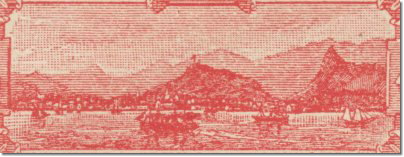
Whitney's first order, dated September 6, 1883, was sent to the American Bank Note Company together with a sketch of Honolulu Harbor
made by Whitney in the 1850's and used in the masthead of one of Honolulu's leading newspapers, The Pacific Commercial Advertiser. He
sent the ABNCo. detailed instructions for altering the sketch in order to update the appearance of Honolulu as seen from a ship rounding
Diamond Head. In the ABNCo. engraving, the hills rising immediately behind the town were exaggerated.
|
|
Design showing Honolulu Harbor as produced from the sketch and instructions given by Whitney. The hills rising immediately behind the
town were exaggerated in the ABNCo. design.
|
|
Order Details
In a December 15, 1883 letter, Whitney amended his original order by increasing the number of 2¢ and 5¢ envelopes. Whitney's first order,
as amended December 15, 1883, called for 400,000 envelopes, broken down as follows (in quality, X=thin, XX=medium and XXX=thick) The
following table shows the details of Whitney's 1883 order. The "knife" used by the ABNCo. to shape the envelopes is added, as is the PS
number for the particular envelope.
| Value |
Envelope Color |
Size |
Quality (thickness) |
Stamp Color |
Quantity |
Knife |
PS# |
| 1¢ |
white |
5 |
X |
green |
10,000 |
P-9 |
PS-1 |
| 2¢ |
white |
5 |
X |
pink |
50,000 |
P-9 |
PS-3 |
| 2¢ |
white |
5 |
XX |
pink |
50,000 |
P-9 |
PS-3 |
| 2¢ |
white |
5 |
XXX |
pink |
50,000 |
P-9 |
PS-2 |
| 2¢ |
white |
6 |
X |
pink |
10,000 |
P-10 |
PS-4 |
| 2¢ |
white |
6 |
XX |
pink |
15,000 |
P-10 |
PS-4 |
| 4¢ |
white |
6 |
XX |
vermilion |
10,000 |
P-10 |
PS-6 |
| 4¢ |
white |
6 |
XXX |
vermilion |
10,000 |
P-10 |
PS-6 |
| 5¢ |
white |
5 |
XX |
blue |
20,000 |
P-9 |
PS-8 |
| 5¢ |
white |
6 |
X |
blue |
20,000 |
P-10 |
PS-9 |
| 5¢ |
white |
6 |
XX |
blue |
50,000 |
P-10 |
PS-9 |
| 5¢ |
white |
6 |
XXX |
blue |
50,000 |
P-10 |
PS-9 |
| 10¢ |
white |
6 |
XX |
black |
25,000 |
P-10 |
PS-14 |
| 10¢ |
white |
6 |
XXX |
black |
20,000 |
P-10 |
PS-15 |
| 10¢ |
white |
23 |
XXX |
black |
10,000 |
P-12 |
PS-17 |
|
- Whitney instructed the ABNCo. to make some of the envelopes with a blue tinted inside. He specified
blue insides envelopes for the following values: 2¢ (PS-5), 4¢ (PS-7), 5¢
(PS-10) and 10¢ (PS-15). These envelopes all were size 6 printed on XX (medium thickness) quality. No precise quantity was given for the
numbers of blue inside envelopes desired.
- In the 2¢ envelopes, 100,000 of size 5 were printed with dotted address lines (UPSS 4a), comprising the entire order for X and XX quality in
the 2¢ size 5, leaving the order for 50,000 of XXX quality 2¢ size 5 envelopes without address lines. The 2¢ envelopes with address lines were
intended for use by "natives."
- For the 4¢ value, Whitney included an example of Scott No. 31 to show the color he
desired.
- The December 15 amendment increased the quantity of 2¢ and 5¢ envelopes to be made (the foregoing table gives the amended quantity) and
also requested "specimens of each variety of envelopes and denomination of stamps when possible sent by mail."
Production
Woodblocks were engraved separately for each value and electrotype dies were made from the woodblocks to form the base for
typography printing. Die proofs were sent to Honolulu for approval. Final design approval is said to have been given on January 31, 1884.
Production was sub-contracted to George F. Nesbitt & Co. of New York City. That firm produced the early United States stamped
envelopes. The Nesbitt company produced all of the Hawaii envelopes.
|

|

|

|
|
1¢ orange trial color proof on card
|
10¢ blue trial color proof
|
10¢ die proof on card with C-115 at top
|
|
Delivery
Whitney was in no obvious hurry to put the envelopes on sale. Rather than incur freight charges to have the envelopes sent direct to San
Francisco by railroad (a two to three week trip, depending upon the number of layover days in San Francisco), he directed a partial
shipment be sent via Panama (a two month trip) with the balance sent by Cape Horn (a six month trip). All of the envelopes were shipped
by the ABNCo. on March 27, 1884. The shipment sent via Panama was received on June 9, 1884 and included some portion of all types
ordered, including all of the blue inside envelopes. Whitney requisitioned the first of these envelopes from the Treasury vault on June 13,
1884. Thus, on that date presumably all types of the envelopes were available to the public. The remainder coming via Cape Horn was
shipped on the bark Oregon and was finally received on October 4.
Whitney ordered the 1¢ envelopes to be printed in "green". The envelopes received
were green, but inking variations caused some to be dark green. The envelope paper is creamy-white, but age and environment have
affected the paper of many envelopes. This latter point is true for all of the envelopes ordered from the American Bank Note Company.
Regarding the 2¢ envelopes ordered in "pink", the ABNCo. produced them with
indicia printed in a dull rose for the size 5 envelopes and in a brighter rose for the size 6 envelopes.
No further orders ever were placed for the 4¢, 5¢ or 10¢ values. Additional orders were placed for the 1¢ and 2¢
values.
1885 1¢ ORDER
An order was sent in 1885 for 20,000 more 1¢ envelopes, to be made in size 6 with medium thickness (B). These envelopes were received April 4, 1885. As with the 2¢, 4¢, 5¢ and 10¢ size 6 envelopes made in the first printing, these 1¢ envelopes were cut with knife P-10. The color of the indicia is a distinct bluish-green, with some having a considerably darker appearance. The envelopes were printed on white paper, but age and environment have degraded the paper of many envelopes, creating a "buff" or "creamy white" appearance. Catalogue listings fail to note the bluish-green color of the indicia from this printing, but the "medium green" and "dark green" colors used in the catalogs are intended to refer to the shades of this printing. Studies of the chemical elements used in these inks show the bluish green ("medium green" in the catalog) and darker bluish green ("dark green" in the catalog) are the same ink, and the color variation resulted from using more or less ink rather than a change of ink. Although including a separate listing for an appearance caused by over-inking is perhaps unwarranted by most catalogue standards, its presence in the catalogs warrants including it in the list below The bluish-green shade is designated PS-20 and the dark bluish-green shade is PS-21.
JANUARY 14, 1889 1¢ AND 2¢ ORDER
An order for small quantities of the 1¢ and 2¢ values was dated January 14, 1889, and delivered April 11, 1889. For this order, the
ABNCo. used knife P-11a. Only 5,000 of each value was ordered and they are distinct.
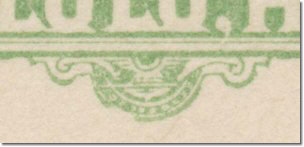
The 1¢ value was made on size 6, in a pale green shade, medium paper (B) (PS-22). The bottom ornament in the stamp of the 1¢
envelopes sent in fulfillment of this order appears undamaged, as it did on earlier envelopes. This envelope is quite scarce. Used examples
are unknown. Envelopes of the 1¢ value printed after June, 1889, show a flaw in the bottom ornament. The 1¢ "flaw" envelope produced
after June, 1889 is PS-25, and is common.
|

|
|
|
UPSS 3, No flaw
|
UPSS 3a, Flaw
|
|
The 2¢ indicia printed on the envelopes sent in fulfillment of the January
14, 1889 order came in a bright rose color (PS-23), brighter than the 1883 size 6 envelopes, and cut with a
P-11a knife. These envelopes are quite
rare. Neither Scott Catalogue nor the UPSS catalogue list this bright rose color.
JUNE 4, 1889 1¢ AND 2¢ ORDER AND SUBSEQUENT ORDERS
Orders for additional envelopes of the 1¢ and 2¢ values were placed beginning June 4, 1889. All envelopes produced
pursuant to these orders were printed on number 6 medium weight envelopes with
knife P-11b.
- For the 1¢ value, orders of 25,000 each were dated June 4, 1889,
April 27, 1892 and November 17, 1892, for a total of 75,000 envelopes. All were printed in a yellow-green shade,
with the flaw at the bottom of the ornament (PS-25).
- For the 2¢ value, orders were dated June 4, 1889 (25,000), May 3, 1890 (25,000), July 30, 1891 (25,000), April 27, 1892 (50,000)
and November 17, 1892 (50,000), for a total additional 175,000 envelopes. The order for 2¢ envelopes on June 4, 1889 specified "same
as last" and Postmaster General Wundenberg commented the quality of the envelopes received from the January 14, 1889 order was
"very satisfactory". However, the envelopes produced for the June 4, 1889 order prompted Wundenberg to complain when he re-ordered
on May 3, 1890. Wundenberg wrote the color was "light pink," and called it a "poor color" "fading away on exposure".
The Nesbitt Company used buff color coated ("glazed") paper for these envelopes, so there is a distinct waxy feel to them. The transient nature of the ink creates ranges from a rosy pink to a pale, light pink. Oxidation evident on some covers also contributes to the color range seen. X-ray fluoroscopy examination of the chemical elements shows a wide range of envelopes with the waxy feel have the same ink. The paper of these envelopes is not to be confused with some of the later red envelopes with "shiny" paper caused by sizing. Wundenberg specified "carmine rose" should be used for the May 3, 1890 order. The pink
envelopes are listed as PS-24. Earlier writers mistook the pink envelopes for the 5,000 envelope printing and called it rare. However, it is
encountered much more frequently than the rare bright rose of PS-23. The indicia on 2¢
envelopes sent in fulfillment of the orders starting May 3, 1890 were printed in carmine (PS-30) and red (PS-31). The decision
to move from the carmine to the red indicia was made by the American Bank Note Company or the Nesbitt company without a color
change order coming from the Hawaii Postmaster General. It is believed the red indicia comprised the last two printings.
WELLS FARGO IMPRINTED FRANKS
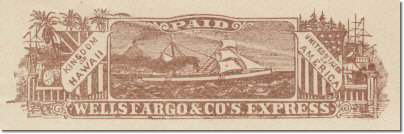
Stamped envelopes were sold to Wells Fargo and Company and were imprinted with a brown frank designed by Wells Fargo for its
Honolulu office. A proof made from the wood block die used for the Wells Fargo imprint is in the files of the California Historical Society in
San Francisco. Electrotype dies were made from the master wood block die. Wells Fargo used only the 5¢ and 10¢ envelopes, having no
need for envelopes paying the Hawaii domestic rates. The Wells Fargo frank is known printed in brown and gray-brown. A defective "G" is
noted in both shades.
|
|

|
|
Wells Fargo imprint in Brown.
|
Wells Fargo imprint in gray-brown with a defective "G"
|
|
The Wells Fargo 5¢ value is found only on size 6 envelopes (PS-11 and PS-13) but the 10¢ value is seen on both the size 6 (PS-16) and size 23
(PS-18 and PS-19) envelopes. Go to Advertising Covers for an example of usage. The 5¢ size 6
envelope with blue inside was also printed with the Wells Fargo frank (PS-12). However, the Wells Fargo frank is unknown on a 10¢ envelope with
blue inside. The Wells Fargo imprint is also seen on stamped envelopes issued by the United States Post Office Department and on blank envelopes to
which postage stamps were affixed.
Wells Fargo sold the franked envelopes to customers who used its services. The frank indicated the Wells Fargo fee was paid.
Wells Fargo imprints on unused United States postal stationery must be viewed with suspicion because quantities were printed in 1890 for sale to
collectors well after commercial need for them had ceased. A counterfeit blue-black Wells Fargo frank is also known and may date from the 1890's.
Known "uses" of the blue-black frank bear a bogus Wells Fargo handstamp in which the final “O” at the end of “Francisco” is raised.
|

|
|
A bogus blue-black frank and bogus San Francisco Wells Fargo mark dated February 22, 1884 added to an unaddressed Hawaii #6 5¢ envelope canceled with a genuine Honolulu Wells Fargo mark dated February 15, 1884. The envelope probably was affixed to the back of an envelope carried by Wells Fargo and served to prove Hawaii postage was paid.
|
|
PROVISIONAL GOVERNMENT OVERPRINTS
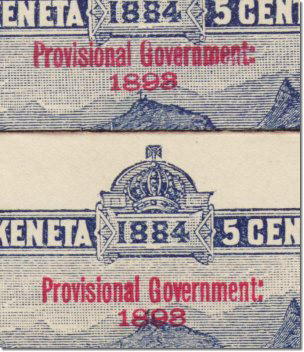
A decision to overprint the stamped envelopes was made and on August 15, 1893 all of the envelopes on hand at the Honolulu Post Office or in the Treasury vault were sent for overprinting to the Press Publishing Company in Honolulu. The overprinting of the 1¢, 5¢ and 10¢ envelopes was done in carmine or red ink. In the image below, carmine is on top and red is below. The 2¢ envelopes were overprinted in black. The overprinted envelopes were placed on sale August 28, 1893.
By 1893, some of the envelopes were sold out and are unknown with the overprint. Of the 1¢ envelopes, all of those without the "flaw" were sold out, including all of the 1¢ size 5 envelopes. Only the yellow-green size 6 1¢ envelopes with the flaw were overprinted (PS-28).
Of the 2¢ envelopes, those printed on size 5 envelopes as well as the size 6 envelopes printed in bright rose or pink were sold out and only the size 6 envelopes printed in carmine (PS-30) or red (PS-31)were overprinted. All of the 4¢ envelopes were sold out and no 4¢ envelope is known with the overprint. Both sizes of the 5¢ (PS-35 and PS-37) and 10¢ (PS-40 and PS-44) envelopes were overprinted.
Of the blue inside envelopes, only the 10¢ size 6 envelope was overprinted (PS-43).
|
|
|
OVERPRINT ERRORS
Printer errors during the overprinting process created double overprints, double
overprints with one inverted at the bottom left, and triple overprints.
None of the printer error varieties is common and of the double overprints in unused condition, the 1¢ is particularly rare. Triple
overprints or used double overprints are exceptionally rare. Send me an E-mail (scott312@earthlink.net) with information
about examples of double or triple overprints.
As overprinted, the envelopes are designated as follows:
|
| Value |
Unoverprinted
PS Number |
Overprinted
PS Number |
Quantity |
| 1¢ green (flaw) |
PS-25 |
PS-28 |
16,000 |
| double overprint |
|
PS-29 |
? |
| 2¢ carmine |
PS-26 |
PS-30 |
37,000 |
| 2¢ red |
PS-27 |
PS-31 |
included w/PS-30 |
| double overprint |
- |
PS-32 |
? |
| double overprint, one inverted |
- |
PS-33 |
? |
| triple overprint |
|
PS-34 |
? |
| 5¢ blue, size 5 |
PS-8 |
PS-35 |
39,293 |
| double overprint |
- |
PS-36 |
? |
| 5¢ blue, size 6 |
PS-9 |
PS-37 |
included w/PS-35 |
| double overprint |
|
PS-38 |
? |
| triple overprint |
|
PS-39 |
? |
| 10¢ black, size 6 |
PS-14 |
PS-40 |
17,707 |
| double overprint |
|
PS-41 |
? |
| triple overprint |
|
PS-42 |
? |
| blue inside |
PS-15 |
PS-43 |
? |
| 10¢ black, size 23 |
PS-17 |
PS-44 |
included w/PS-40 |
| double overprint |
|
PS-45 |
? |
|
SPECIAL DELIVERY ESSAY
Whitney expected to institute a special delivery service in 1885. Anticipating approval, he ordered 2,000 of the 10¢ size 6 envelopes imprinted with a
Special Despatch Letter frank. However, the Minister of the Interior (whose jurisdiction included the Postal Service) rejected the proposed special
delivery service. The imprinted envelopes thus became "essays" in philatelic terms. In December, 1885, the essays were returned to the Treasury vault
until in late 1893, they were sold as "curios" to J. T. Waterhouse of Honolulu. Some of these essays are known canceled. The envelopes are listed as
PS-46.
|
|
|
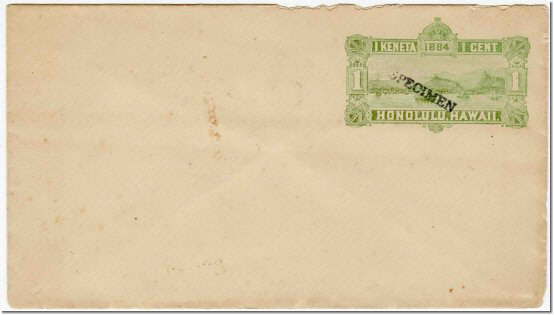
UPU Specimen Overprints
Hawaii furnished postal envelopes to the Universal Postal Union for distribution to member countries. Those countries sometimes placed overprints
indicating "SPECIMEN" or "ULTRAMAR" across the indicia on the face of the envelopes.
|
|
|
Errors, Freaks and Oddities
Apart from the printer errors mentioned above under the Provisional Government overprint section, various freaks and oddities were
created in the process of printing or overprinting the envelopes. One often seen "freak" is the so-called "set-off" reversed indicia
impression on the inside of an envelope (often erroneously called an "offset impression"). This phenomenon probably happened when the
press depressed without any paper in it, leaving an inked impression on the platen. When the next paper entered the press, the reverse
side picked up the ink from the platen as the indicia was being printed on the face. Another "freak" is the set-off reversed impression of
the Provisional Government overprint on the reverse side of the envelope. This freak probably happened when an envelope was stacked
on top of a freshly overprinted envelope and ink transferred from the one to the back of the other. Infrequently seen are envelopes with
the indicia printed diagonally or with the overprint placed diagonally. Examples also exist of blank envelopes with the indicia printed on the
inside, and blank envelopes overprinted. All of these freaks and oddities are collectible depending on whether one chooses to include
them.
|
SEQUENTIAL PRINTING LIST, WITH EARLIEST
DOCUMENTED USES
|
| My No. |
UPSS #/ Scott No. |
Value/Size/ Knife/Color |
Issue Date |
EDU |
Notes |
| PS-1 |
1 U1a |
1¢/#5/P-9/ green or dark green |
June 13, 1884 |
July 1, 1884 or 1885 |
Local use postmarked with Honolulu type 234.62 in use to May, 1886 |
| PS-2 |
4 U2b |
2¢/#5/P-9/ dull rose |
June 13, 1884 |
Oct. 14, 1884 |
To Germany |
| PS-3 |
4a U2b |
2¢/#5/P-9/ dull rose (lines) |
June 13, 1884 |
Sept. 4, 1884 |
Laupahoehoe to Honolulu |
| PS-4 |
5 U2b |
2¢/#6/P-10/ bright rose |
June 13, 1884 |
Sept. 4, 1884 |
From Kealakekua, interisland use |
| PS-5 |
12 U6 |
2¢/#6/P-10/ bright rose (blue inside) |
June 13, 1884 |
July 22, 1884 |
Local use in Honolulu |
| PS-6 |
7 U3 |
4¢/#6/P-10/ vermilion |
June 13, 1884 |
Feb. 14, 1885 |
Honolulu to Nova Scotia |
| PS-7 |
13 U7 |
4¢/#6/P-10/ vermilion (blue inside) |
June 13, 1884 |
Sept. 11, 1889 |
Local use in Honolulu |
| PS-8 |
8 U4 |
5¢/#5/P-9 blue |
June 13, 1884 |
Sept. 26, 1885 |
From Lahaina |
| PS-9 |
9 U4 |
5¢/#6/P-10 blue |
June 13, 1884 |
June 16, 1884 |
Tennessee |
| PS-10 |
14 U8 |
5¢/#6/P-10 blue (blue inside) |
June 13, 1884 |
April 15, 1886 |
To San Francisco - and make the same insertion for PS-11 and PS-12 |
| PS-11 |
9a (1) U4 |
5¢/#6/P-10 blue (WF brown) |
July 8, 1884 |
May 2, 1886 |
|
| PS-12 |
14a U8 |
5¢/#6/P-10 blue (WF brown) (blue inside) |
July 8, 1884 |
Nov. 14, 1885 |
|
| PS-13 |
9a (2) U4 |
5¢/#6/P-10 blue (WF gray-brn) |
July 8, 1884 |
|
|
| PS-14 |
10 U5 |
10¢/#6/P-10/ black |
June 13, 1884 |
Jul. 12, 1884 |
To Germany |
| PS-15 |
15 U9 |
10¢/#6/P-10/ black (blue inside) |
June 13, 1884 |
Sept. 1, 1886 |
To London
|
| PS-16 |
10a U5 |
10¢/#6/P-10/ black (WF brown) |
July 8, 1884 |
|
|
| PS-17 |
11 U5 |
10¢/#23/P-12/ black |
June 13, 1884 |
Oct. 30, 1885 |
To Germany |
| PS-18 |
11a (1) U5 |
10¢/#23/P-12/ black (WF brown) |
July 8, 1884 |
July 29, 1887 |
|
| PS-19 |
11a (2) U5 |
10¢/#23/P-12/ black (WF gray-brn) |
July 8, 1884 |
|
|
| PS-20 |
2 U1 |
1¢/#6/P-10/ bluish green |
March 27, 1885 |
March 2, 1886 |
Local use in Honolulu |
| PS-21 |
2a U1b |
1¢/#6/P-10/dark bluish green |
March 27, 1885 |
Feb. 23, 1886 |
Local use in Honolulu |
| PS-22 |
3 U1 |
1¢/#6/P-11/ pale green |
May 6, 1889 |
|
|
| PS-23 |
6 U2c |
2¢/#6/P-11/ bright rose |
May 8, 1889 |
April 4, 1890 |
Kaunakakai to Honolulu |
| PS-24 |
6 U2c |
2¢/#6/P-11/ pink |
Oct. 24, 1889 |
Dec. 17, 1889 |
|
| PS-25 |
3a U1 |
1¢/#6/P-11/ yellow-green (flaw) |
Oct. 24, 1889 |
Jan. 15, 1890 |
To Germany |
| PS-26 |
6a U2 |
2¢/#6/P-11/ carmine |
March 14, 1891 |
March 28, 1891 |
Honolulu to Haiku |
| PS-27 |
6a U2a |
2¢/#6/P-11/ red |
Aug. 1892 |
Sep. 21, 1892 |
Kaneohe, Oahu, to Honolulu |
| PS-28 |
16a U10a |
1¢PG/#6/P-11/ yellow-green (flaw) |
Aug. 28, 1893 |
Sept. 4, 1893 |
Local use in Honolulu |
| PS-29 |
16b U10a |
1¢PG/#6/P-11/ yellow-green (flaw) double o/pnt |
Aug. 28, 1893 |
|
|
| PS-30 |
17 U11 |
2¢PG/#6/P-11/ carmine |
Aug. 28, 1893 |
Sept. 4, 1893 |
Local use in Honolulu |
| PS-31 |
17a U11 |
2¢PG/#6/P-11/ red |
Aug. 28, 1893 |
Aug. 28, 1893 |
Local use in Honolulu |
| PS-32 |
17b U11a |
2¢PG/#6/P-11/ red double o/pnt |
Aug. 28, 1893 |
Jan. 11, 1895 |
To Conn. |
| PS-33 |
- U11b |
2¢PG/#6/P-11/ red double o/pnt one inverted |
Aug. 28, 1893 |
|
|
| PS-34 |
17c - |
2¢PG/#6/P-11/ red triple o/pnt |
Aug. 28, 1893 |
|
|
| PS-35 |
18 U12 |
5¢PG/#5/P-9 blue |
Aug. 28, 1893 |
Sept. 13, 1893 |
To SF |
| PS-36 |
18 U12a |
5¢PG/#5/P-9 blue double overprint |
Aug. 28, 1893 |
Nov. 1, 1893 |
To California |
| PS-37 |
19 U12 |
5¢PG/#6/P-10 blue |
Aug. 28, 1893 |
Aug. 28, 1893 |
Local use in Honolulu |
| PS-38 |
19a U12a |
5¢PG/#6/P-10 blue double o/pnt |
Aug. 28, 1893 |
Jan. 5, 1895 |
To Conn. |
| PS-39 |
19c U12b |
5¢PG/#6/P-10 blue triple o/pnt |
Aug. 28, 1893 |
May 31, 1894 |
Advertiser, lot 3716 Hono. to Calif. |
| PS-40 |
20 U13 |
10¢PG/#6/P-10/ black |
Aug. 28, 1893 |
Aug. 28, 1893 |
Local use in Honolulu |
| PS-41 |
20a U13a |
10¢PG/#6/P-10/ black double o/pnt |
Aug. 28, 1893 |
Sept. 4, 1893 |
Local use in Honolulu |
| PS-42 |
20b - |
10¢PG/#6/P-10/ black triple o/pnt |
Aug. 28, 1893 |
|
|
| PS-43 |
22 U14 |
10¢PG/#6/P-10/ black (blue inside) |
Aug. 28, 1893 |
Jan. 5, 1894 |
To Germany |
| PS-44 |
21 U13 |
10¢PG/#23/ P-12/black |
Aug. 28, 1893 |
Oct. 11, 1893 |
To SF |
| PS-45 |
21a U13a |
10¢PG/#23/ P-12/black double o/pnt |
Aug. 28, 1893 |
Sept. 4, 1893 |
|
| PS-46 |
SDE 1 UE1 |
10¢PG/#6/P-10/ black (special delivery) |
- |
July 7, 1893 |
Local use in Honolulu |
|
POSTAL ENVELOPES BIBLIOGRAPHY
|
- Bruns, James H., "Hawaii's First Stamped Envelopes", The United States Specialist, Vol. 59, No. 1, front
cover and p. 9-18, Jan., 1988. Describes the artifacts housed at the National Philatelic Collection and details of
the orders given by PMG Whitney.
- Krieger, George T., editor, The Postal Stationery of the Possessions and Administrative Areas of the United States, 3rd Edition, United Postal
Stationery Society, 2009; up-to-date with complete listings and values; a key reference work and more accurate than the Schwalm edition (see below)
listing of postal cards, envelopes, essays, proofs, and archival material, but not a replacement for the background material in the Schwalm edition. The
Hawaii section of the Krieger edition was assisted by several current collectors and exhibitors of Hawaii postal stationery.
- Schwalm, Albert J., editor, The Postal Stationery of Hawaii, Hawaii Postal Stationery Study Group, United
Postal Stationery Society, Redlands, Ca., 1982 (errata [page laid in); correction noted by editor at Mitchell's
Hawaiian Philatelist, Vol. 5, No. 1, p. 2, 1983. Key reference treatise, but see corrections and additions listed
below.
- Schwalm, Albert J., "Thru Thick and Thin", Mitchell's Hawaiian Philatelist, Vol. 4, No. 4, p. 45, 1982;
correction at Vol. 4, No. 5, p. 51, 1982; reprinted (as corrected) at Po'Oleka O Hawaii, No. 32, p. 17, July,
1983. Gives detail measurements of envelope thickness.
- Schwalm, Albert J., "Additions To The Postal Stationery Of Hawaii", Postal Stationery, Vol. 26, No. 4,
[221], p. 90-106, July-August, 1984. Corrects the 1982 UPSS edition based upon new evidence obtained
from PMG orders; essential for anyone using the UPSS catalogue.
- Schwalm, Albert J., "Shipping Data on Hawaii's Envelopes", Postal Stationery, Vol. 27, No. 2, [231], p.
47-50, March-April, 1985; reprinted at Po'Oleka O Hawaii, No. 40, p. 10-15, July, 1985; Possessions, Vol.
12, No. 3, p. 8-10, Third Quarter, 1989. Sailing data pertaining to the first shipment of stamped envelopes.
- Schwalm, Albert J., "Corrections To The Postal Stationery Of Hawaii", Postal Stationery, Vol. 28, No. 2,
[237], p. 37-39, March-April, 1986. Additional corrections to the UPSS 1982 edition; essential for anyone
using that catalogue.
|
|

|
|
Copyright © 1999 - 2020 POST OFFICE IN PARADISE. All rights reserved.
|
|